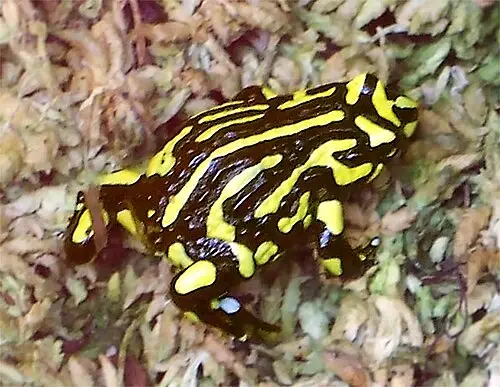
 📸 Photo
Photo: No machine-readable author provided. Andrew c assumed (based on copyright claims). · CC BY-SA 3.0 · Wikimedia Commons Source
Southern Corroboree Frog
Pseudophryne corroboree (Southern Corroboree Frog · コロボリーヒキガエルモドキ)
💡 Everyday Comparisons for Size, Mass & Speed
- 💡 Its body length of 3 cm is slightly larger than the diameter of a Korean 500-won coin (26.5 mm) (Comparison).
- 💡 Although its entire habitat lies within Kosciuszko National Park, it is threatened by habitat damage from feral pigs and horses as well as chytrid fungus disease, so programs are underway to rear tadpoles and frogs in captivity and release them back into the wild (NSW Government).
Reference standards: coach bus ~12 m, mid-size car ~4.9 m, compact car ~1 t, basketball hoop 3.05 m, credit card 8.56 cm.
📖 1. Overview
The Southern Corroboree Frog is a tiny frog found only in sphagnum bogs of the Snowy Mountains in New South Wales, Australia, notable for its bright yellow and black stripes. It is listed as Critically Endangered (CR, 2022 assessment) on the IUCN Red List.
🦴 2. Anatomy & Morphology
Alternating bright yellow and black longitudinal stripes run down its back while its belly is marbled with black, yellow, and white, and adult body length is 2.5–3 cm. Its call is a short 'squelch' sound, and its tadpoles are dark brown to black.
🔍 3. Ecology & Behavior
It feeds on small black ants and other invertebrates. In summer, males call beside pools in mossy bogs and females lay 20–30 large eggs in terrestrial nests; tadpoles overwinter in pools and metamorphose in early summer of the following year.
🇰🇷 4. Connection to Korea
No direct record connecting this species to Korea has been found.
📚 Sources & References
- • IUCN Red List CR (2022) — https://www.iucnredlist.org/species/18582/78432063
- • IUCN Red List category CR — latest assessment at iucnredlist.org
- • catalogueoflife.org — 4P7G4
- • iucnredlist.org — 78432063
- • wikidata.org — Q2296149
- • commons.wikimedia.org — File:CorroboreeFrog.jpg
- • threatenedspecies.bionet.nsw.gov.au — profile
Recorded dimensions are widely cited representative estimates from public literature and may vary by study or specimen.