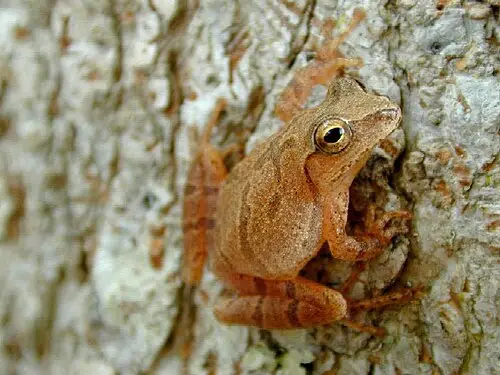
 📸 Photo
Photo: USGS · Public domain · Wikimedia Commons Source
Spring Peeper
Pseudacris crucifer (Spring Peeper · Spring Peeper)
💡 Everyday Comparisons for Size, Mass & Speed
- 💡 Its body length of 25 mm is almost the same as a Korean 100-won coin (24 mm in diameter), and its maximum weight of 5 g is about that of four Korean 10-won coins (1.22 g) (Comparison).
- 💡 By eating small insects it helps control pest populations, and on early spring nights males can be heard chorusing 'peep-peep' around pools (ADW).
Reference standards: coach bus ~12 m, mid-size car ~4.9 m, compact car ~1 t, basketball hoop 3.05 m, credit card 8.56 cm.
Site-computed relative index from recorded values; not a formal scientific metric.
📖 1. Overview
The Spring Peeper is a tiny treefrog living in marshy woods and lowland wetlands of North America, famous for its high-pitched 'peep' call in early spring.
🦴 2. Anatomy & Morphology
Its adult body length is only 20–25 mm. Usually brown, gray, or olive, it has a dark cross (X) mark on the back, dark bands on the legs, and a cream belly, along with moderate webbing and noticeable pads at the tips of its fingers and toes.
🔍 3. Ecology & Behavior
It feeds on small insects such as ants, beetles, flies, and spiders. One of the first frogs to begin breeding after winter hibernation, hundreds of males gather at small pools from March to June to give 'peep-peep' calls, and females lay about 800–1,000 eggs.
🇰🇷 4. Connection to Korea
No direct record connecting this species to Korea has been found.
📚 Sources & References
- • IUCN Red List LC (2022) — https://www.iucnredlist.org/species/55892/193392474
- • IUCN Red List category LC — latest assessment at iucnredlist.org
- • catalogueoflife.org — 4NH9F
- • iucnredlist.org — 193392474
- • wikidata.org — Q135015
- • commons.wikimedia.org — File:H crucifer USGS.jpg
- • animaldiversity.org — Pseudacris crucifer
- • bok.or.kr — contents.do
- • Silhouette: PhyloPic — Beth Reinke · CC0 1.0 (Congeneric silhouette — Pseudacris maculata)
Recorded dimensions are widely cited representative estimates from public literature and may vary by study or specimen.