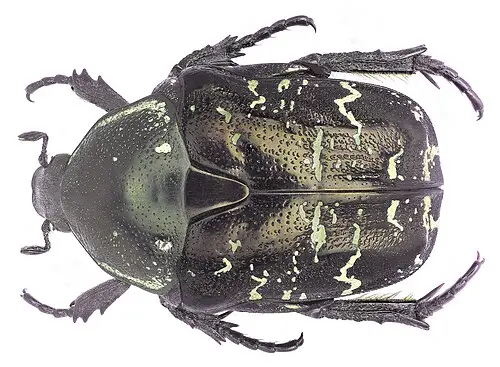
 📸 Photo
Photo: Udo Schmidt from Deutschland · CC BY-SA 2.0 · Wikimedia Commons Source
White-spotted flower chafer
Protaetia brevitarsis (White-spotted flower chafer · シラホシハナムグリ)
Not Evaluated (NE) on the IUCN Red List yet.
💡 Everyday Comparisons for Size, Mass & Speed
- 💡 A body length of 22 mm is slightly smaller than a Korean 100-won coin (24 mm in diameter) (Comparison).
- 💡 Materials from the Rural Development Administration list fruits such as apples, pears, bananas, and peaches as food for adults, and well-fermented rice straw or oak sawdust as food for larvae.
Reference standards: coach bus ~12 m, mid-size car ~4.9 m, compact car ~1 t, basketball hoop 3.05 m, credit card 8.56 cm.
📖 1. Overview
The white-spotted flower chafer is a scarab beetle in the family Scarabaeidae seen throughout Korea and also distributed in eastern Siberia and Japan (Tsushima).
🦴 2. Anatomy & Morphology
Measuring 17–22 mm in body length, it is glossy coppery black with irregular white to yellowish-white markings and numerous pitted grooves on the pronotum and elytra. It is a slightly flattened, sturdy-looking chafer that flies well.
🔍 3. Ecology & Behavior
Adults appear from April to October (most abundant in July–August) and feed on tree sap or fruit juice. Larvae live in humus-rich soil such as rotten wood, fallen leaves, haystacks, and compost, and usually overwinter as larvae.
🇰🇷 4. Connection to Korea
The National List of Species of Korea records it from about 70 mountain, field, and island localities nationwide, including North Korea, central and southern Korea, Jeju Island, and Ulleungdo.
📚 Sources & References
- • IUCN Red List: not evaluated (NE) — cross-checked with the Wikidata conservation-status entry
- • catalogueoflife.org — 77Z8M
- • 국가생물종목록(국립생물자원관) ktsn 120000015213 — https://species.nibr.go.kr/home/mainHome.do?cont_link=009&subMenu=009002&contCd=009002&ktsn=120000015213
- • wikidata.org — Q12626253
- • commons.wikimedia.org — File:Protaetia brevitarsis brevitarsis Lewis, 1879 (30194568
- • species.nibr.go.kr — mainHome.do
- • genebank.rda.go.kr — insectView.bo
- • Silhouette: PhyloPic — Edwin Price · CC BY 4.0 (Related taxon silhouette — Hylamorpha elegans)
Recorded dimensions are widely cited representative estimates from public literature and may vary by study or specimen.