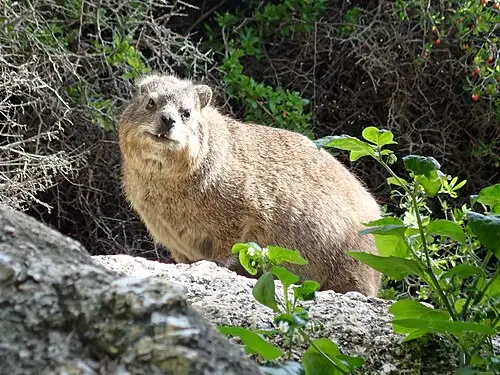
 📸 Photo
Photo: Andrawaag · CC BY-SA 4.0 · Wikimedia Commons Source
Rock Hyrax
Procavia capensis (Rock Hyrax · ケープハイラックス)
💡 Everyday Comparisons for Size, Mass & Speed
- 💡 "Hyraceum," hardened in the group's communal latrines, was used as a medicine for illnesses such as epilepsy.
- 💡 In South Africa, it sometimes lives in road culverts and stone walls and is regarded as a pest.
- 💡 Its maximum weight of 4.3 kg is about that of a single house cat (Comparison).
Reference standards: coach bus ~12 m, mid-size car ~4.9 m, compact car ~1 t, basketball hoop 3.05 m, credit card 8.56 cm.
Site-computed relative index from recorded values; not a formal scientific metric.
📖 1. Overview
The Rock Hyrax is a small herbivorous animal that lives in groups in rocky areas of Africa and Arabia.
🦴 2. Anatomy & Morphology
It has 4 toes on each forefoot and 3 on each hindfoot, along with a pair of long, strong tusk-like incisors. On its back is a gland used for signaling.
🔍 3. Ecology & Behavior
It feeds mainly on grass and also eats bark and lichens during droughts. It lives in groups of up to 80 individuals, with a single male accompanying 3–7 females.
🇰🇷 4. Connection to Korea
No direct record connecting this species to Korea has been found.
📚 Sources & References
- • IUCN Red List LC (2026) — https://www.iucnredlist.org/species/41766/278607316
- • IUCN Red List category LC — latest assessment at iucnredlist.org
- • mammaldiversity.org — 1000528
- • iucnredlist.org — 278607316
- • wikidata.org — Q323847
- • commons.wikimedia.org — File:Cape Dassie.jpg
- • animaldiversity.org — Procavia capensis
- • Silhouette: PhyloPic — Natalie Kestel · CC BY 4.0
Recorded dimensions are widely cited representative estimates from public literature and may vary by study or specimen.