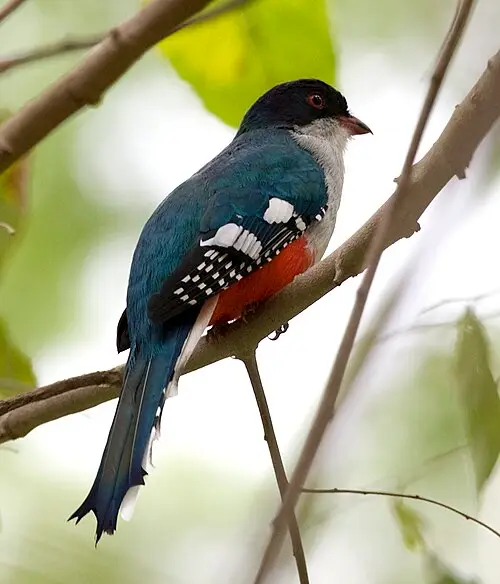
 📸 Photo
Photo: Laura Gooch · CC BY-SA 2.0 · Wikimedia Commons Source
Cuban Trogon
Priotelus temnurus (Cuban Trogon · キューバキヌバネドリ)
💡 Everyday Comparisons for Size, Mass & Speed
- 💡 Its local name 'Tocororo' comes from its repeated 'toco-toco-tocoro-tocoro' call.
- 💡 As the national bird of Cuba, it is known for having the same plumage colors (blue, white, and red) as the national flag.
- 💡 The average entrance diameter of nest cavities surveyed in Cuban wetlands is about 7.1 cm, slightly larger than the diameter of a beverage can (about 6.6 cm) (Comparison).
Reference standards: coach bus ~12 m, mid-size car ~4.9 m, compact car ~1 t, basketball hoop 3.05 m, credit card 8.56 cm.
📖 1. Overview
The Cuban Trogon (Tocororo) is an endemic bird found only in Cuba and is Cuba's national bird. Its plumage colors match those of the Cuban national flag.
🦴 2. Anatomy & Morphology
Its back is iridescent dark bluish-green, its crown and nape are violet-blue, its throat and breast are grayish-white, and its belly and eyes are bright red. The wings and tail are patterned in blue, black, green, and white, the undertail is mostly white, and the tips of the tail feathers flare outward.
🔍 3. Ecology & Behavior
It moves little, does not readily flee when approached by people, and travels alone or in pairs. It eats flowers, fruits, insects, and Anolis lizards—which it also feeds to its chicks—and instead of building its own nest, lays 3–4 eggs in abandoned woodpecker holes or natural cavities.
🇰🇷 4. Connection to Korea
No direct record connecting this species to Korea has been found.
📚 Sources & References
- • IUCN Red List LC (2018) — https://www.iucnredlist.org/species/22682748/130082349
- • IUCN Red List category LC — latest assessment at iucnredlist.org
- • doi.org — avilist.v2026
- • iucnredlist.org — 130082349
- • wikidata.org — Q742552
- • commons.wikimedia.org — File:Priotelus temnurus -Camaguey, Camaguey Province, Cuba-8
- • birdscaribbean.org — from-the-nest-day-42
- • jco.birdscaribbean.org — 1484
- • Silhouette: PhyloPic — Keith Murdock (photo), John E. McCormack, Michael G. Harvey, Brant C. Faircloth, Nicholas G. Crawford, Travis C. Glenn, Robb T. Brumfield & T. Michael Keesey · CC BY 3.0 (Related taxon silhouette — Trogon personatus)
Recorded dimensions are widely cited representative estimates from public literature and may vary by study or specimen.