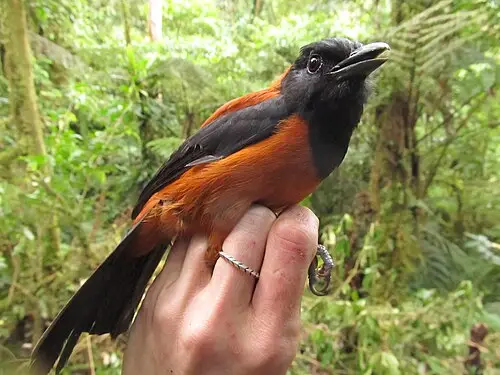
 📸 Photo
Photo: Benjamin Freeman · CC BY 4.0 · Wikimedia Commons Source
Hooded Pitohui
Pitohui dichrous (Hooded Pitohui · ズグロモリモズ)
💡 Everyday Comparisons for Size, Mass & Speed
- 💡 When a researcher first touched a feather to his mouth, his mouth reportedly felt numb and burning (California Academy of Sciences).
- 💡 Experiencing numbness in the hands while handling this bird caught in a net led to the discovery of its poison (California Academy of Sciences).
Reference standards: coach bus ~12 m, mid-size car ~4.9 m, compact car ~1 t, basketball hoop 3.05 m, credit card 8.56 cm.
📖 1. Overview
The Hooded Pitohui is a bird living in New Guinea, famous as one of the few birds with poison in its skin and feathers.
🦴 2. Anatomy & Morphology
It is a black-and-orange bird about the size of a jay. Its skin and feathers contain a toxin called homobatrachotoxin.
🔍 3. Ecology & Behavior
The dietary source of its toxin is thought to be small beetles (Choresine), and its stomach contents have yielded these beetles along with various small arthropods and seeds. People in New Guinea have long known this bird as an 'inedible bird.'
🇰🇷 4. Connection to Korea
No direct record connecting this species to Korea has been found.
📚 Sources & References
- • IUCN Red List LC (2018) — https://www.iucnredlist.org/species/22705576/130390714
- • IUCN Red List category LC — latest assessment at iucnredlist.org
- • doi.org — avilist.v2026
- • iucnredlist.org — 130390714
- • wikidata.org — Q232619
- • commons.wikimedia.org — File:Hooded Pitohui 1.jpg
- • researcharchive.calacademy.org — horizons.html
- • pmc.ncbi.nlm.nih.gov — PMC528779
- • birdsoftheworld.org — introduction
- • Silhouette: PhyloPic — Charles J. Sharp · CC BY 4.0 (Related taxon silhouette — Oriolus auratus)
Recorded dimensions are widely cited representative estimates from public literature and may vary by study or specimen.