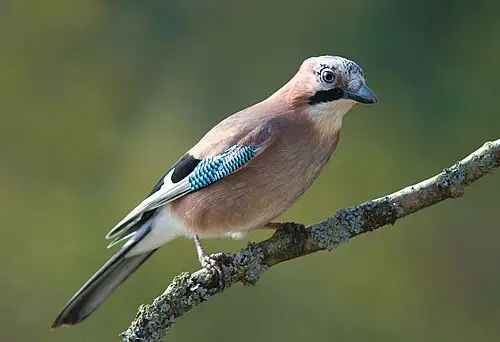
 📸 Photo
Photo: Luc Viatour · CC BY-SA 3.0 · Wikimedia Commons Source
Eurasian Jay
Garrulus glandarius (Eurasian Jay · カケス)
💡 Everyday Comparisons for Size, Mass & Speed
- 💡 A single bird can hide 4,500–11,000 acorns and find and eat them up to ten months later (ADW).
- 💡 A study in a Swedish park calculated that having humans plant acorns instead would cost 1–6 million kronor, putting a monetary value on the Eurasian Jay's work in regenerating oak forests (ADW).
- 💡 Its weight of 170 g is lighter than a medium-sized apple (about 200 g) (Comparison).
Reference standards: coach bus ~12 m, mid-size car ~4.9 m, compact car ~1 t, basketball hoop 3.05 m, credit card 8.56 cm.
Site-computed relative index from recorded values; not a formal scientific metric.
📖 1. Overview
The Eurasian Jay is a mainly arboreal bird in the crow family, a common resident breeding throughout Korea that has a habit of burying acorns in the ground.
🦴 2. Anatomy & Morphology
Its back and belly are pinkish-brown, its rump is white, and its tail is black. Its wing coverts have blue and black bars, its streaked crown feathers can be raised into a low crest, and it has a broad black malar stripe.
🔍 3. Ecology & Behavior
Acorns make up the largest part of its diet, buried in autumn and eaten into the following year. It nests in deciduous broadleaf or mixed forests, lays 5–6 eggs from April to June, calls fiercely when alarmed, and sometimes mimics the sounds of other animals.
🇰🇷 4. Connection to Korea
According to the National List of Species of Korea, it is a common resident bird breeding throughout Korea.
📚 Sources & References
- • IUCN Red List LC (2025) — https://www.iucnredlist.org/species/103723684/153832514
- • IUCN Red List category LC — latest assessment at iucnredlist.org
- • doi.org — avilist.v2026
- • iucnredlist.org — 153832514
- • 국가생물종목록(국립생물자원관) ktsn 120000001954 — https://species.nibr.go.kr/home/mainHome.do?cont_link=009&subMenu=009002&contCd=009002&ktsn=120000001954
- • wikidata.org — Q25354
- • commons.wikimedia.org — File:Garrulus glandarius 1 Luc Viatour.jpg
- • animaldiversity.org — Garrulus glandarius
- • species.nibr.go.kr — mainHome.do
- • Silhouette: PhyloPic — Martin Bulla, based on Brian Small's illustration · CC BY 4.0
Recorded dimensions are widely cited representative estimates from public literature and may vary by study or specimen.