 📸 Photo
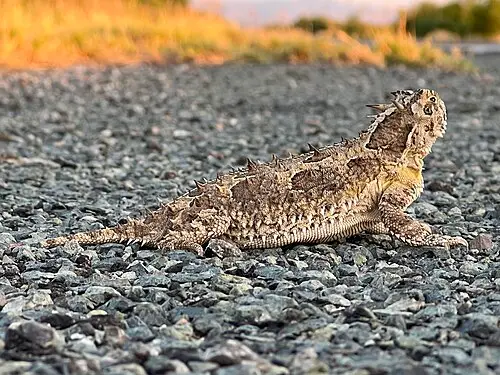
Photo: Brandon Bourassa · CC BY 4.0 · Wikimedia Commons Source
Texas Horned Lizard
Phrynosoma cornutum (Texas Horned Lizard · Texas Horned Lizard)
💡 Everyday Comparisons for Size, Mass & Speed
- 💡 It is sometimes captured and sold as a pet, but organizations such as the Texas wildlife authorities oppose this because its numbers are declining and it does not survive well in captivity (positive impacts on humans in ADW).
- 💡 A maximum weight of 90 g is about the weight of one and a half chicken eggs (Comparison).
Reference standards: coach bus ~12 m, mid-size car ~4.9 m, compact car ~1 t, basketball hoop 3.05 m, credit card 8.56 cm.
Site-computed relative index from recorded values; not a formal scientific metric.
📖 1. Overview
The Texas Horned Lizard is a lizard living on dry open ground in the southern United States, with horns on its head and a short, round body.
🦴 2. Anatomy & Morphology
Horns including two brow horns grow on its head, and two rows of spikes line both sides of its torso. Its body is short and round, and females are larger than males.
🔍 3. Ecology & Behavior
It mainly eats harvester ants, with ants making up 69% of stomach contents, lapping them up quickly with its sticky tongue. It lives alone, and its breeding season runs from mid-month 4, right after hibernation, to mid-month 6.
🇰🇷 4. Connection to Korea
No direct record connecting this species to Korea has been found.
📚 Sources & References
- • IUCN Red List LC (2007) — https://www.iucnredlist.org/species/64072/12741535
- • IUCN Red List category LC — latest assessment at iucnredlist.org
- • catalogueoflife.org — 4GWSM
- • iucnredlist.org — 12741535
- • wikidata.org — Q748410
- • commons.wikimedia.org — File:Phrynosoma cornutum 293505046.jpg
- • animaldiversity.org — Phrynosoma cornutum
- • Silhouette: PhyloPic — Jose Carlos Arenas-Monroy · CC0 1.0 (Congeneric silhouette — Phrynosoma orbiculare)
Recorded dimensions are widely cited representative estimates from public literature and may vary by study or specimen.