 📸 Photo
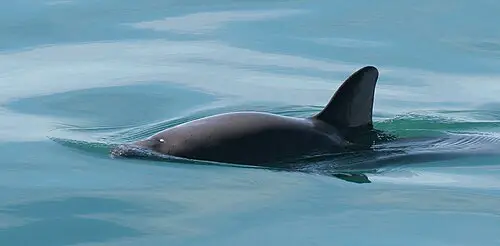
Photo: Paula Olson , NOAA · Public domain · Wikimedia Commons Source
Vaquita
Phocoena sinus (Vaquita · コガシラネズミイルカ)
💡 Everyday Comparisons for Size, Mass & Speed
- 💡 Its habitat lies within about 1,519 square miles (about 3,900 km²) east of San Felipe, less than 1/4 the size of metropolitan Los Angeles.
- 💡 Its maximum body length of 1.5 m is slightly smaller than a 1.7 m tall adult (Comparison).
Reference standards: coach bus ~12 m, mid-size car ~4.9 m, compact car ~1 t, basketball hoop 3.05 m, credit card 8.56 cm.
Site-computed relative index from recorded values; not a formal scientific metric.
📖 1. Overview
The Vaquita is a tiny porpoise living only in the northern Gulf of California in Mexico, and is a rare marine mammal assessed as Critically Endangered (CR).
🦴 2. Anatomy & Morphology
It has a small, sturdy body with a rounded head and no beak. It has black patches around its eyes and lips, a dark gray back, and a pale gray belly, with a taller and wider dorsal fin than other porpoises.
🔍 3. Ecology & Behavior
It feeds on small fish near the surface, crustaceans such as shrimp, and squid. Travelling alone or in pairs and avoiding boats with running engines, it is rarely seen.
🇰🇷 4. Connection to Korea
No direct record connecting this species to Korea has been found.
📚 Sources & References
- • IUCN Red List CR (2022) — https://www.iucnredlist.org/species/17028/214541137
- • IUCN Red List category CR — latest assessment at iucnredlist.org
- • mammaldiversity.org — 1006451
- • iucnredlist.org — 214541137
- • wikidata.org — Q725493
- • commons.wikimedia.org — File:Vaquita4 Olson NOAA.jpg
- • animaldiversity.org — Phocoena sinus
- • fisheries.noaa.gov — vaquita
- • Silhouette: PhyloPic — author not recorded · CC0 1.0
Recorded dimensions are widely cited representative estimates from public literature and may vary by study or specimen.