 📸 Photo
Photo: пресс-служба ПАО "Газпром нефть" · CC BY-SA 4.0 · Wikimedia Commons Source
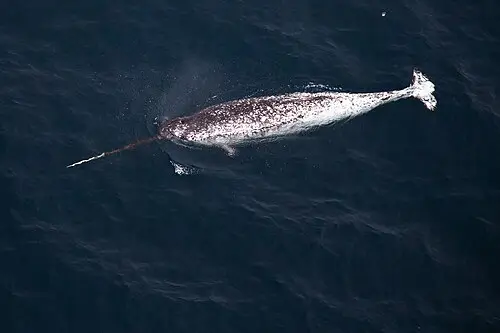
Narwhal
Monodon monoceros (Narwhal · イッカク)
💡 Everyday Comparisons for Size, Mass & Speed
- 💡 A tusk up to 3 m long is nearly twice the height of a 1.7 m adult human (Comparison).
- 💡 Indigenous peoples of Greenland and Canada have traditionally used its blubber for lamps, heating, and cooking, its skin (muktuk) as a source of vitamin C, its sinews as thread, and its meat as food for sled dogs.
Reference standards: coach bus ~12 m, mid-size car ~4.9 m, compact car ~1 t, basketball hoop 3.05 m, credit card 8.56 cm.
Site-computed relative index from recorded values; not a formal scientific metric.
📖 1. Overview
The Narwhal is an Arctic whale best known for the long, spiral tusk that extends from the upper lip of males.
🦴 2. Anatomy & Morphology
The long tusk is an overgrown left canine tooth that reaches up to 3 m in length and spirals to the left. It has no dorsal fin, and its head is small and rounded. Young whales are brownish-gray and develop white mottling as they grow.
🔍 3. Ecology & Behavior
It feeds on Greenland halibut and squid in autumn and winter and polar cod in spring, while appearing to eat very little in summer. It usually lives in pods of 2–25 individuals, which merge into groups of several hundred during migration.
🇰🇷 4. Connection to Korea
No direct record connecting this species to Korea has been found.
📚 Sources & References
- • IUCN Red List LC (2017) — https://www.iucnredlist.org/species/13704/50367651
- • IUCN Red List category LC — latest assessment at iucnredlist.org
- • mammaldiversity.org — 1006445
- • iucnredlist.org — 50367651
- • wikidata.org — Q159426
- • commons.wikimedia.org — File:Нарвал в российской Арктике.jpg
- • animaldiversity.org — Monodon monoceros
- • fisheries.noaa.gov — narwhal
- • Silhouette: PhyloPic — author not recorded · CC0 1.0
Recorded dimensions are widely cited representative estimates from public literature and may vary by study or specimen.