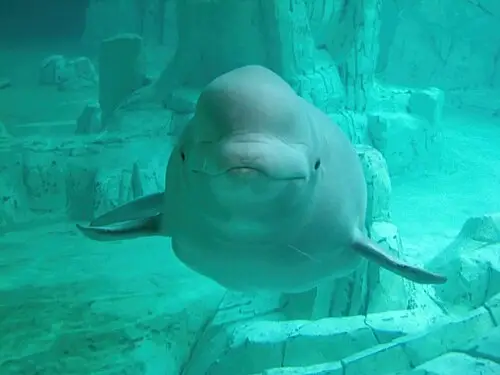
 📸 Photo
Photo: Carquinyol from Badalona, Catalunya · CC BY-SA 2.0 · Wikimedia Commons Source
Beluga
Delphinapterus leucas (Beluga · シロイルカ)
💡 Everyday Comparisons for Size, Mass & Speed
- 💡 An adult eats about 25 kg of fish and crustaceans combined per day—just over one 20 kg bag of rice (Comparison).
- 💡 For Inuit communities in Canada and Alaska, it has long been a vital food source and its blubber was also used for oil.
- 💡 Its loud, varied vocalizations earned it the nickname 'canary of the sea.'
Reference standards: coach bus ~12 m, mid-size car ~4.9 m, compact car ~1 t, basketball hoop 3.05 m, credit card 8.56 cm.
Site-computed relative index from recorded values; not a formal scientific metric.
📖 1. Overview
The Beluga is a white whale living in seas near the Arctic, called the 'canary of the sea' for the many sounds it makes.
🦴 2. Anatomy & Morphology
Adults are pure white all over while calves are pale gray. It has no dorsal fin, a small rounded head, and a more flexible neck than other whales. Its thick blubber layer forms folds along its body.
🔍 3. Ecology & Behavior
It feeds mainly on fish such as salmon, herring, and cod, as well as squid, shrimp, and crabs, capturing prey by suction. Usually seen in pods of 2–10, it gathers by the hundreds or thousands during summer migrations and gives birth in shallow estuaries.
🇰🇷 4. Connection to Korea
It is listed as 'Huindol-gorae' (Korean name) on the National List of Species of Korea, where it is recorded as potentially occurring throughout Korean waters.
📚 Sources & References
- • IUCN Red List LC (2017) — https://www.iucnredlist.org/species/6335/50352346
- • IUCN Red List category LC — latest assessment at iucnredlist.org
- • mammaldiversity.org — 1006444
- • iucnredlist.org — 50352346
- • 국가생물종목록(국립생물자원관) ktsn 120000053403 — https://species.nibr.go.kr/home/mainHome.do?cont_link=009&subMenu=009002&contCd=009002&ktsn=120000053403
- • wikidata.org — Q132072
- • commons.wikimedia.org — File:Beluga oceanografic.jpg
- • species.nibr.go.kr — mainHome.do
- • animaldiversity.org — Delphinapterus leucas
- • Silhouette: PhyloPic — Steven Traver · CC0 1.0
Recorded dimensions are widely cited representative estimates from public literature and may vary by study or specimen.