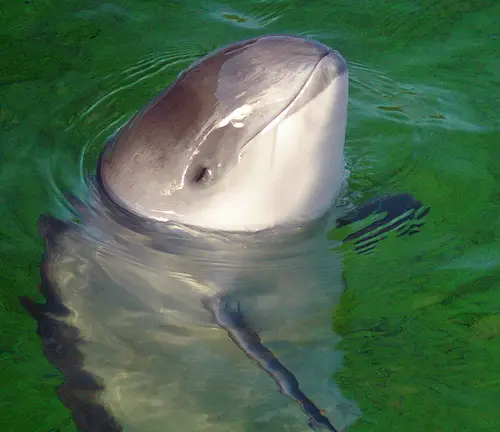
 📸 Photo
Photo: AVampireTear · CC BY-SA 3.0 · Wikimedia Commons Source
Harbor Porpoise
Phocoena phocoena (Harbor Porpoise · ネズミイルカ)
💡 Everyday Comparisons for Size, Mass & Speed
- 💡 Its maximum weight of 65 kg is about the weight of an adult human (Comparison).
- 💡 Heavily caught in several regions, its meat was used for human and livestock food and its oil for lamps and lubricants.
Reference standards: coach bus ~12 m, mid-size car ~4.9 m, compact car ~1 t, basketball hoop 3.05 m, credit card 8.56 cm.
Site-computed relative index from recorded values; not a formal scientific metric.
📖 1. Overview
The Harbor Porpoise is a small cetacean living in cold coastal waters of the Northern Hemisphere that travels quietly without following boats.
🦴 2. Anatomy & Morphology
It has a chubby body, a rounded head with a short snout, and a low triangular dorsal fin in the middle of its back. Its back is dark gray, its belly is white, and its upper and lower jaws hold 19–28 pairs of spade-shaped teeth.
🔍 3. Ecology & Behavior
It feeds on schooling fish such as herring and saury as well as cephalopods, using echolocation to find prey. Usually seen alone, in pairs, or in groups of 5–10, it rolls quietly at the surface to breathe without splashing.
🇰🇷 4. Connection to Korea
It is listed as 'Soe-dol-go-rae' (Harbor Porpoise) on the National List of Species of Korea and has been recorded throughout all Korean waters.
📚 Sources & References
- • IUCN Red List LC (2023) — https://www.iucnredlist.org/species/17027/247632759
- • IUCN Red List category LC — latest assessment at iucnredlist.org
- • mammaldiversity.org — 1006450
- • iucnredlist.org — 247632759
- • 국가생물종목록(국립생물자원관) ktsn 120000053408 — https://species.nibr.go.kr/home/mainHome.do?cont_link=009&subMenu=009002&contCd=009002&ktsn=120000053408
- • wikidata.org — Q27027
- • commons.wikimedia.org — File:Daan Close Up.PNG
- • animaldiversity.org — Phocoena phocoena
- • species.nibr.go.kr — mainHome.do
- • fisheries.noaa.gov — harbor-porpoise
- • Silhouette: PhyloPic — Matthew Schmitz · CC0 1.0
Recorded dimensions are widely cited representative estimates from public literature and may vary by study or specimen.