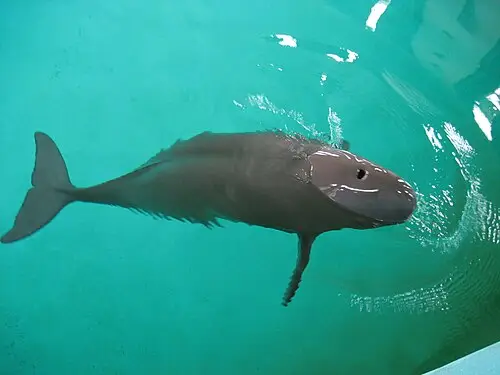
 📸 Photo
Photo: Yohkawa · CC BY-SA 4.0 · Wikimedia Commons Source
Yangtze Finless Porpoise
Neophocaena asiaeorientalis (Yangtze Finless Porpoise · ヨウスコウスナメリ)
🇰🇷 Marine Protected Species (Korea)
💡 Everyday Comparisons for Size, Mass & Speed
- 💡 A body length of about 1.9 m is slightly longer than a 1.7 m adult human (Comparison).
- 💡 It is a protected marine species that can be encountered throughout Korean waters.
Reference standards: coach bus ~12 m, mid-size car ~4.9 m, compact car ~1 t, basketball hoop 3.05 m, credit card 8.56 cm.
📖 1. Overview
The Yangtze Finless Porpoise is a small porpoise lacking a dorsal fin that lives in Indo-Pacific coastal waters and large rivers such as the Yangtze River.
🦴 2. Anatomy & Morphology
It lacks both a dorsal fin and a beak, having a rounded forehead and a very flexible neck. Its body is gray, while individuals in the Yangtze River population are nearly black, and it has 13–22 pairs of teeth in the upper and lower jaws.
🔍 3. Ecology & Behavior
It eats small fish, shrimp, and squid, and occasionally plant matter. It usually travels alone or in pairs, sometimes gathering in groups of up to about twelve, and mothers have been observed carrying calves on the small tuberculated ridge on their backs.
🇰🇷 4. Connection to Korea
It is listed as "Sanggwaengi" (Korean name) in the National List of Species of Korea and is a protected marine species recorded throughout Korean waters.
📚 Sources & References
- • IUCN Red List EN (2017) — https://www.iucnredlist.org/species/41754/50381766
- • 해양보호생물 — 국가생물종목록(국립생물자원관) ktsn 120000209297 — https://species.nibr.go.kr/home/mainHome.do?cont_link=009&subMenu=009002&contCd=009002&ktsn=120000209297
- • IUCN Red List category EN — latest assessment at iucnredlist.org
- • Korean protection status: Marine Protected Species (Korea)
- • mammaldiversity.org — 1006446
- • iucnredlist.org — 50381766
- • 국가생물종목록(국립생물자원관) ktsn 120000209297 — https://species.nibr.go.kr/home/mainHome.do?cont_link=009&subMenu=009002&contCd=009002&ktsn=120000209297
- • wikidata.org — Q22286308
- • commons.wikimedia.org — File:Yangtze River Snammer 01.jpg
- • species.nibr.go.kr — mainHome.do
- • Silhouette: PhyloPic — author not recorded · CC0 1.0
Recorded dimensions are widely cited representative estimates from public literature and may vary by study or specimen.