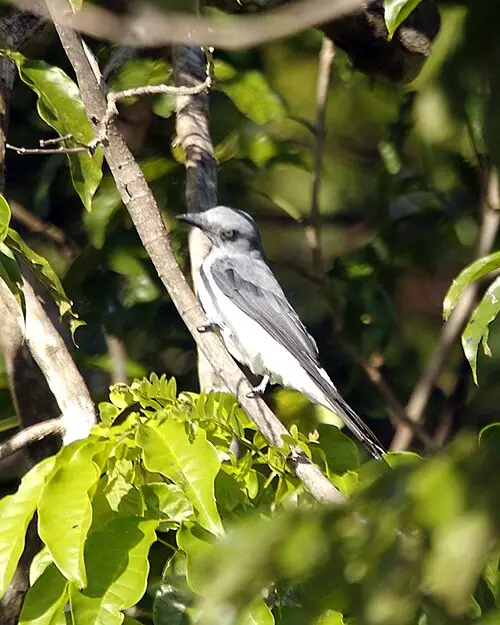
 📸 Photo
Photo: Lip Kee Yap from Singapore, Republic of Singapore · CC BY-SA 2.0 · Wikimedia Commons Source
Ashy Minivet
Pericrocotus divaricatus (Ashy Minivet · サンショウクイ)
💡 Everyday Comparisons for Size, Mass & Speed
- 💡 Its body length of 20 cm is almost the same as the short side of an A4 sheet of paper (21 cm) (Comparison).
- 💡 Because it also nests in the tops of tall trees near houses, it can be observed near villages (National List of Species of Korea).
Reference standards: coach bus ~12 m, mid-size car ~4.9 m, compact car ~1 t, basketball hoop 3.05 m, credit card 8.56 cm.
📖 1. Overview
The Ashy Minivet is a relatively common summer visitor on the Korean Peninsula that winters in Southeast Asia.
🦴 2. Anatomy & Morphology
In males, the forehead to the front half of the crown is white, while the back of the head, hindneck, and eye line are black. The tail is black with long, slender wedge-shaped white markings at the tips, and the bill and legs are black.
🔍 3. Ecology & Behavior
Pairs stay together during the breeding season and form flocks during migration. It lays 4–5 eggs per clutch in May–June and feeds mainly on insects.
🇰🇷 4. Connection to Korea
According to the National List of Species of Korea, it is a relatively common summer visitor in the central-northern Korean Peninsula and South Korea.
📚 Sources & References
- • IUCN Red List LC (2018) — https://www.iucnredlist.org/species/22706735/130428286
- • IUCN Red List category LC — latest assessment at iucnredlist.org
- • doi.org — avilist.v2026
- • iucnredlist.org — 130428286
- • 국가생물종목록(국립생물자원관) ktsn 120000001930 — https://species.nibr.go.kr/home/mainHome.do?cont_link=009&subMenu=009002&contCd=009002&ktsn=120000001930
- • wikidata.org — Q1590357
- • commons.wikimedia.org — File:Ashy Minivet (Pericrocotus divaricatus).jpg
- • species.nibr.go.kr — mainHome.do
- • Silhouette: PhyloPic — author not recorded · CC0 1.0 (Congeneric silhouette — Pericrocotus flammeus)
Recorded dimensions are widely cited representative estimates from public literature and may vary by study or specimen.