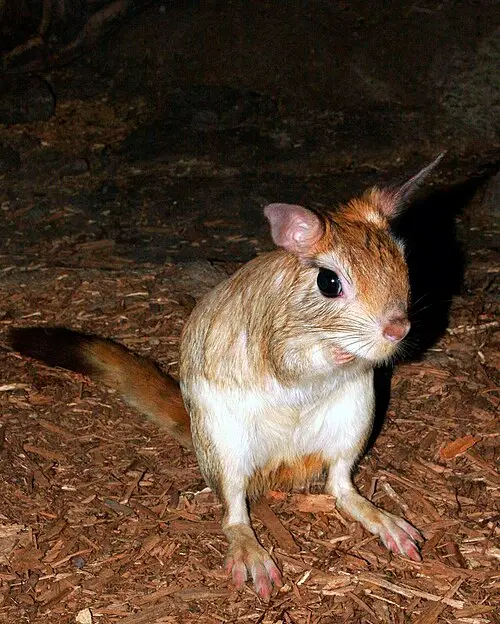
 📸 Photo
Photo: Devonpike at English Wikipedia · Public domain · Wikimedia Commons Source
Southern African Springhare
Pedetes capensis (Southern African Springhare · トビウサギ)
💡 Everyday Comparisons for Size, Mass & Speed
- 💡 Its maximum weight of 4 kg is equal to a 4 kg bag of rice (Comparison).
- 💡 Because it likes barley, oats, and wheat from fields, some individuals live around grain farms.
Reference standards: coach bus ~12 m, mid-size car ~4.9 m, compact car ~1 t, basketball hoop 3.05 m, credit card 8.56 cm.
Site-computed relative index from recorded values; not a formal scientific metric.
📖 1. Overview
The Southern African Springhare is a large African rodent that hops on its hind legs like a kangaroo.
🦴 2. Anatomy & Morphology
It has short forelimbs and long, sturdy hind limbs with four clawed toes on each hind foot. Its ears have a tragus that blocks sand while digging burrows, and the tip of its tail has a black tuft of hair.
🔍 3. Ecology & Behavior
It rests in burrows during the day and comes out at night to eat grains such as barley, oats, and wheat, as well as grasses, beetles, and locusts. When startled, it leaps like a kangaroo; pairs use several burrows and usually give birth to one young at a time.
🇰🇷 4. Connection to Korea
No direct record connecting this species to Korea has been found.
📚 Sources & References
- • IUCN Red List LC (2016) — https://www.iucnredlist.org/species/16467/115133584
- • IUCN Red List category LC — latest assessment at iucnredlist.org
- • mammaldiversity.org — 1001845
- • iucnredlist.org — 115133584
- • wikidata.org — Q732890
- • commons.wikimedia.org — File:Springharelg.jpg
- • animaldiversity.org — Pedetes capensis
- • Silhouette: PhyloPic — Margot Michaud · CC0 1.0
Recorded dimensions are widely cited representative estimates from public literature and may vary by study or specimen.