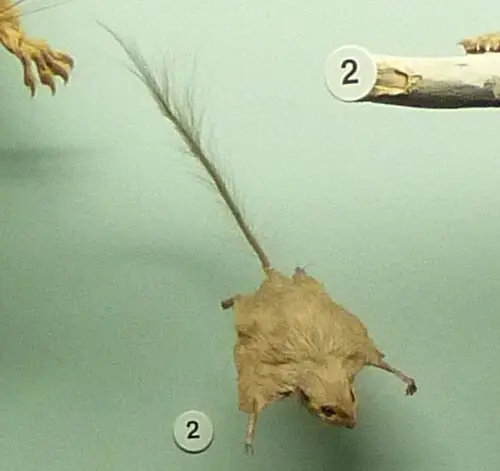
 📸 Photo
Photo: Eveha , via Totodu74 · CC BY-SA 3.0 · Wikimedia Commons Source
Zenker's Pygmy Anomalure
Idiurus zenkeri (Zenker's Pygmy Anomalure · Zenker's Pygmy Anomalure)
💡 Everyday Comparisons for Size, Mass & Speed
- 💡 Its average weight of 17.4 g is just over the weight of three Korean 100-won coins (about 5.4 g each) (Comparison).
- 💡 Its maximum body length of 7.5 cm is about half the long side of a smartphone (about 15 cm) (Comparison).
- 💡 It is known to feed even on oil palm fruits.
Reference standards: coach bus ~12 m, mid-size car ~4.9 m, compact car ~1 t, basketball hoop 3.05 m, credit card 8.56 cm.
Site-computed relative index from recorded values; not a formal scientific metric.
📖 1. Overview
Zenker's Pygmy Anomalure is the smallest of the scaly-tailed squirrels, living in the trees of tropical forests.
🦴 2. Anatomy & Morphology
It has a body length of 63–75 mm and a tail length of 83–104 mm, with a gliding membrane between its forelimbs and hindlimbs. Its fur is silky, and two rows of pinecone-like scales run along the underside of the tail.
🔍 3. Ecology & Behavior
Active at night, up to 100 individuals roost together in tree hollows or behind peeling bark. It eats fruit, nuts, tree sap, and bark, and glides about 3 m between trees without losing height.
🇰🇷 4. Connection to Korea
No direct record connecting this species to Korea has been found.
📚 Sources & References
- • IUCN Red List LC (2016) — https://www.iucnredlist.org/species/10796/22183649
- • IUCN Red List category LC — latest assessment at iucnredlist.org
- • mammaldiversity.org — 1001844
- • iucnredlist.org — 22183649
- • wikidata.org — Q307834
- • commons.wikimedia.org — File:Idiurus zenkeri Museum de Genève.JPG
- • animaldiversity.org — Idiurus zenkeri
Recorded dimensions are widely cited representative estimates from public literature and may vary by study or specimen.