 📸 Photo
Photo: Jomegat · CC BY-SA 3.0 · Wikimedia Commons Source
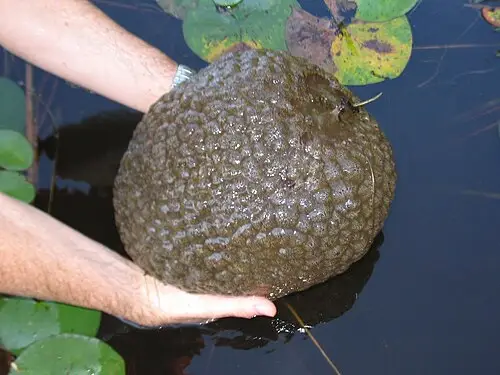
Magnificent bryozoan
Pectinatella magnifica (Magnificent bryozoan · オオマリコケムシ)
Not Evaluated (NE) on the IUCN Red List yet.
💡 Everyday Comparisons for Size, Mass & Speed
- 💡 Its colony clump diameter of 200 mm is similar to that of a soccer ball (diameter about 22 cm) (Comparison).
- 💡 It commonly lives attached to structures and fishing nets in inland fish farms in dam reservoirs (National List of Species of Korea).
Reference standards: coach bus ~12 m, mid-size car ~4.9 m, compact car ~1 t, basketball hoop 3.05 m, credit card 8.56 cm.
📖 1. Overview
The magnificent bryozoan is a freshwater bryozoan that forms gelatinous mass colonies. In Korea, it is abundant in inland fish farms in dam reservoirs.
🦴 2. Anatomy & Morphology
The colony is shaped like a large rugby ball, with small colony clumps gathered on a common gelatinous base secreted by the zooids. Each small colony clump reaches 200 mm in diameter, and white dots appear on the surface because cuticular glands around the orifice secrete a white substance.
🔍 3. Ecology & Behavior
It never attaches to the green parts of living aquatic plants, attaching only to inanimate objects such as fishing nets or fish farm structures. In old colonies, the center degenerates so that living zooids remain only along the edges, and its statoblasts are only of the floating round type.
🇰🇷 4. Connection to Korea
It is listed on the National List of Species of Korea and is abundant in inland fish farms in dam reservoirs across Gangwon-do, Chungcheongbuk-do, Chungcheongnam-do, and Jeollanam-do.
📚 Sources & References
- • IUCN Red List: not evaluated (NE) — cross-checked with the Wikidata conservation-status entry
- • catalogueoflife.org — 6TVNM
- • 국가생물종목록(국립생물자원관) ktsn 120000041626 — https://species.nibr.go.kr/home/mainHome.do?cont_link=009&subMenu=009002&contCd=009002&ktsn=120000041626
- • wikidata.org — Q144410
- • commons.wikimedia.org — File:Pectinatella magnifica 8568.jpg
- • species.nibr.go.kr — mainHome.do
- • sealifebase.se — Pectinatella-magnifica.html
Recorded dimensions are widely cited representative estimates from public literature and may vary by study or specimen.