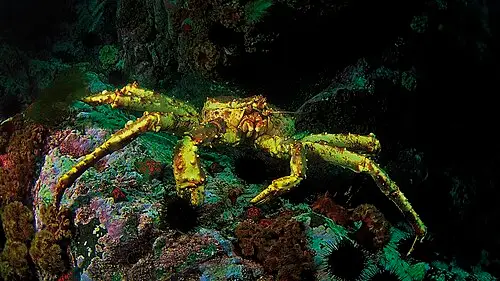
 📸 Photo
Photo: Sasha Isachenko · CC BY-SA 3.0 · Wikimedia Commons Source
Red king crab
Paralithodes camtschaticus (Red king crab · タラバガニ)
Not Evaluated (NE) on the IUCN Red List yet.
💡 Everyday Comparisons for Size, Mass & Speed
- 💡 A leg span of about 1.5 m is about 3/4 the height of a door (about 2 m), and a maximum weight of about 10.9 kg is slightly heavier than a 10 kg bag of rice (Comparison).
- 💡 Animal Diversity Web explains that Alaskan king crabs generated hundreds of millions of dollars in revenue from 1960 to 1970, but overfishing soon reduced catches. Today, regulations allow only males to be harvested.
Reference standards: coach bus ~12 m, mid-size car ~4.9 m, compact car ~1 t, basketball hoop 3.05 m, credit card 8.56 cm.
Site-computed relative index from recorded values; not a formal scientific metric.
📖 1. Overview
The red king crab is a large cold-water crab caught mainly in the North Pacific, which NOAA introduces as the largest of the commercially harvested crabs.
🦴 2. Anatomy & Morphology
Its body is brownish to bluish red and covered in sharp spines. It has 3 pairs of walking legs and 1 pair of claws, one of which is large and heavy-duty for crushing. The abdominal flap is triangular in males and rounded in females.
🔍 3. Ecology & Behavior
It lives in waters at or below 10 °C, spawns in April–May, and migrates to shallow coastal waters during the breeding season. Adults eat fish, bivalves, marine worms, crustaceans, and echinoderms, and it takes about 10 years from egg to reproductive adult.
🇰🇷 4. Connection to Korea
The National List of Species of Korea notes that although historical records reached as far south as Samcheok in Gangwon-do, today only juveniles are very rarely confirmed north of Sokcho. Adults have not been caught along Korea's East Sea coast for a long time.
📚 Sources & References
- • IUCN Red List: not evaluated (NE) — cross-checked with the Wikidata conservation-status entry
- • marinespecies.org — aphia.php
- • 국가생물종목록(국립생물자원관) ktsn 120000049005 — https://species.nibr.go.kr/home/mainHome.do?cont_link=009&subMenu=009002&contCd=009002&ktsn=120000049005
- • wikidata.org — Q721171
- • commons.wikimedia.org — File:Paralithodes camtschaticus, 1.jpg
- • fisheries.noaa.gov — red-king-crab
- • animaldiversity.org — Paralithodes camtschaticus
- • species.nibr.go.kr — mainHome.do
- • sealifebase.se — Paralithodes-camtschaticus.html
Recorded dimensions are widely cited representative estimates from public literature and may vary by study or specimen.