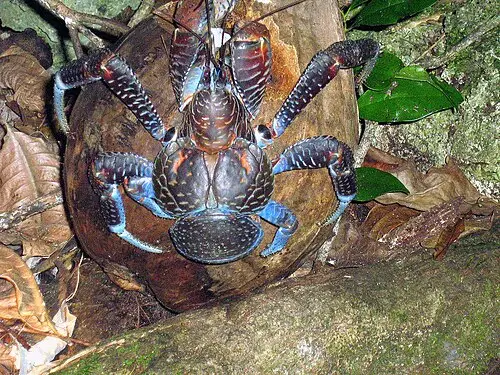
 📸 Photo
Photo: fearlessRich · CC BY 2.0 · Wikimedia Commons Source
Coconut crab
Birgus latro (Coconut crab · ヤシガニ)
💡 Everyday Comparisons for Size, Mass & Speed
- 💡 Its maximum leg span of 1 m from tip to tip is a little over 3 times the long side of an A4 sheet of paper (29.7 cm).
- 💡 Its maximum weight of 4 kg equals the weight of two 2 L bottles of water (taking 1 L of water as 1 kg).
- 💡 Because it feeds on coconut meat and tropical fruits, it is an animal closely connected to the coconuts we eat and drink.
Reference standards: coach bus ~12 m, mid-size car ~4.9 m, compact car ~1 t, basketball hoop 3.05 m, credit card 8.56 cm.
Site-computed relative index from recorded values; not a formal scientific metric.
📖 1. Overview
The coconut crab (Birgus latro) is a terrestrial crab living on tropical islands of the Indian and Pacific Oceans, known as the largest land-living arthropod.
🦴 2. Anatomy & Morphology
It grows to a maximum carapace length of about 200 mm and up to about 1 m from leg tip to leg tip. Males are larger than females, with an average carapace length of 75 mm in males and 50 mm in females, and females have three large feathery pleopods used to carry eggs.
🔍 3. Ecology & Behavior
It is an omnivorous scavenger that eats carrion, the molted shells of other crustaceans, tropical fruits, and coconut meat, sometimes dropping coconuts from trees to crack them open. When molting, it digs a burrow up to about 1 m long and stays inside for 3 to 16 weeks.
🇰🇷 4. Connection to Korea
No direct record connecting this species to Korea has been found.
📚 Sources & References
- • IUCN Red List VU (2020) — https://www.iucnredlist.org/species/2811/126813586
- • IUCN Red List category VU — latest assessment at iucnredlist.org
- • marinespecies.org — aphia.php
- • iucnredlist.org — 126813586
- • wikidata.org — Q206070
- • commons.wikimedia.org — File:Birgus latro.jpg
- • animaldiversity.org — Birgus latro
- • sealifebase.se — Birgus-latro.html
- • Silhouette: PhyloPic — author not recorded · Public Domain Mark 1.0
Recorded dimensions are widely cited representative estimates from public literature and may vary by study or specimen.