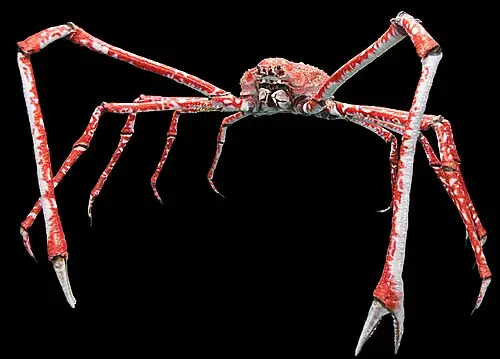
 📸 Photo
Photo: Lycaon (Hans Hillewaert) · CC BY 2.5 · Wikimedia Commons Source
Japanese spider crab
Macrocheira kaempferi (Japanese spider crab · タカアシガニ)
Not Evaluated (NE) on the IUCN Red List yet.
💡 Everyday Comparisons for Size, Mass & Speed
- 💡 A maximum leg span of 3.7 m is slightly shorter than the length of a passenger car (about 4.5 m), and a maximum weight of 20 kg is similar to a 20 kg bag of rice (Comparison).
- 💡 Animal Diversity Web explains that in Japan this crab is eaten both raw and cooked as a delicacy, and that its gentle temperament makes it popular in aquariums.
Reference standards: coach bus ~12 m, mid-size car ~4.9 m, compact car ~1 t, basketball hoop 3.05 m, credit card 8.56 cm.
Site-computed relative index from recorded values; not a formal scientific metric.
📖 1. Overview
The Japanese spider crab is a crab known as the largest living arthropod today, inhabiting the deep sea floor off Japan and Taiwan.
🦴 2. Anatomy & Morphology
Its pear-shaped carapace is only about 37 cm long, but when its claw-bearing legs are stretched wide, its span reaches nearly 4 m. The carapace is dark orange to light brown, covered with blunt tubercles, and it cannot change its body color.
🔍 3. Ecology & Behavior
It is an omnivorous scavenger that crawls along the bottom picking at dead animals and plants, occasionally eating algae or catching easy small invertebrates. It cannot swim, mates in early spring (January–March), and females lay up to 1.5 million eggs per season.
🇰🇷 4. Connection to Korea
No direct record connecting this species to Korea has been found.
📚 Sources & References
- • IUCN Red List: not evaluated (NE) — cross-checked with the Wikidata conservation-status entry
- • marinespecies.org — aphia.php
- • wikidata.org — Q273655
- • commons.wikimedia.org — File:Macrocheira kaempferi.jpg
- • animaldiversity.org — Macrocheira kaempferi
- • sealifebase.se — Macrocheira-kaempferi.html
- • Silhouette: PhyloPic — Andy Wilson · CC0 1.0
Recorded dimensions are widely cited representative estimates from public literature and may vary by study or specimen.