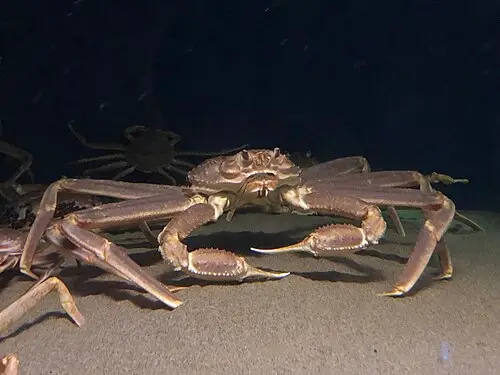
 📸 Photo
Photo: Totti · CC BY-SA 4.0 · Wikimedia Commons Source
Snow crab
Chionoecetes opilio (Snow crab · ズワイガニ)
Not Evaluated (NE) on the IUCN Red List yet.
💡 Everyday Comparisons for Size, Mass & Speed
- 💡 The male's maximum carapace width of 165 mm is similar to the length of two credit cards (long side about 8.6 cm) placed end to end, and the maximum weight of commercial males at 1.35 kg is similar to a 1.5-liter bottle of water (Comparison).
- 💡 Animal Diversity Web explains that this crab is important mainly as food because its meat is sweet, high in protein, and low in fat. After it was judged overfished in 1999, regulations were strengthened to manage it.
Reference standards: coach bus ~12 m, mid-size car ~4.9 m, compact car ~1 t, basketball hoop 3.05 m, credit card 8.56 cm.
Site-computed relative index from recorded values; not a formal scientific metric.
📖 1. Overview
The snow crab is a crab living on cold sea floors of the North Pacific, North Atlantic, and near the Arctic. The National List of Species of Korea records it from the East Sea side of Korea (Hamgyeongbuk-do, Hamgyeongnam-do, Gangwon-do, and Gyeongsangbuk-do).
🦴 2. Anatomy & Morphology
The adult carapace is nearly round and slightly wider than long, with tubercles scattered over its flat back. The rostrum is split into two prongs by a V-shaped notch, and the walking legs are flat and long. Males are much larger and have bigger claws.
🔍 3. Ecology & Behavior
Adults eat benthic invertebrates such as shrimp, polychaete worms, bivalves, sea stars, and squid, and also act as scavengers eating dead animals. They migrate to shallower waters to breed and move to deeper waters as they age.
🇰🇷 4. Connection to Korea
The National List of Species of Korea states that the snow crab is distributed in Hamgyeongbuk-do, Hamgyeongnam-do, Gangwon-do, and Gyeongsangbuk-do, and records a specimen collected in Gyeongju, Gyeongsangbuk-do. It is said to live on mud or soft sand bottoms at depths of 200–350 m.
📚 Sources & References
- • IUCN Red List: not evaluated (NE) — cross-checked with the Wikidata conservation-status entry
- • marinespecies.org — aphia.php
- • 국가생물종목록(국립생물자원관) ktsn 120000049016 — https://species.nibr.go.kr/home/mainHome.do?cont_link=009&subMenu=009002&contCd=009002&ktsn=120000049016
- • wikidata.org — Q798471
- • commons.wikimedia.org — File:Chionoecetes opilio Kanikkokan.jpg
- • animaldiversity.org — Chionoecetes opilio
- • species.nibr.go.kr — mainHome.do
- • sealifebase.se — Chionoecetes-opilio.html
- • Silhouette: PhyloPic — Fisheries and Oceans Canada · CC0 1.0
Recorded dimensions are widely cited representative estimates from public literature and may vary by study or specimen.