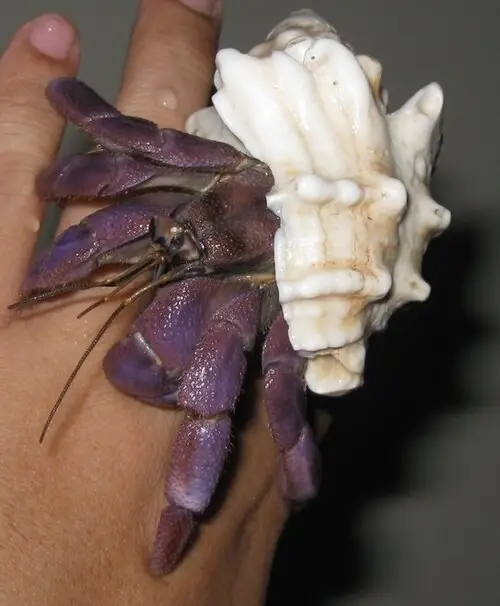
 📸 Photo
Photo: Felix J.Wang · Public domain · Wikimedia Commons Source
Purple land hermit crab
Coenobita purpureus (Purple land hermit crab · ムラサキオカヤドカリ)
Not Evaluated (NE) on the IUCN Red List yet.
💡 Everyday Comparisons for Size, Mass & Speed
- 💡 A shield length of 8 mm is less than half the diameter of a Korean 10-won coin (about 18 mm) (Comparison).
- 💡 Noting that illegal capture of land hermit crabs reached about 3,400 individuals, the Okinawa Prefectural Board of Education asks people to call 110 if they see suspicious parcel boxes or anyone catching hermit crabs in coastal bushes at night.
- 💡 Japanese researchers conducted cold-tolerance experiments on adults (shield length about 7 mm) purchased from a pet dealer.
Reference standards: coach bus ~12 m, mid-size car ~4.9 m, compact car ~1 t, basketball hoop 3.05 m, credit card 8.56 cm.
📖 1. Overview
The purple land hermit crab is a terrestrial hermit crab living only in the northwestern Pacific region, with the northern limit of its range along the Pacific coast of Honshu, Japan (around 35°N). In Japan, land hermit crabs (Okayadokari group) are designated as a National Natural Monument.
🦴 2. Anatomy & Morphology
Adults live on land, with well-developed pincers and thick, sturdy legs (a shared trait of the Okayadokari group). Individuals 1 year or older encountered in a Japanese survey had a shield length of 3–8 mm.
🔍 3. Ecology & Behavior
It releases larvae into the sea in summer, and after about 30–40 days the larvae come ashore carrying snail shells. Newly landed juveniles appear in August, and because they are relatively cold-hardy, some individuals have been found overwintering on beaches in southern Honshu.
🇰🇷 4. Connection to Korea
No direct record connecting this species to Korea has been found.
📚 Sources & References
- • IUCN Red List: not evaluated (NE) — cross-checked with the Wikidata conservation-status entry
- • marinespecies.org — aphia.php
- • wikidata.org — Q13472682
- • commons.wikimedia.org — File:C.purpureus Stramonita armigera 2.jpg
- • zoolstud.sinica.edu.tw — 58-25.pdf
- • online.bunka.go.jp — 203326
- • pref.okinawa.lg.jp — 2poster okayadokari.pdf
- • Silhouette: PhyloPic — Caleb M. Gordon · CC0 1.0 (Congeneric silhouette — Coenobita)
Recorded dimensions are widely cited representative estimates from public literature and may vary by study or specimen.