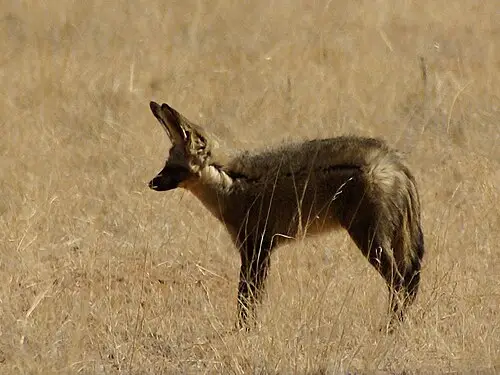
 📸 Photo
Photo: Hans Hillewaert · CC BY-SA 3.0 · Wikimedia Commons Source
Bat-eared Fox
Otocyon megalotis (Bat-eared Fox · オオミミギツネ)
💡 Everyday Comparisons for Size, Mass & Speed
- 💡 A maximum ear length of 13.5 cm is similar to a ballpoint pen (about 14 cm), and a weight of 5.3 kg is about half of a 10 kg bag of rice (Comparison).
- 💡 Though it has no major commercial use, indigenous people in Botswana hunt it for its pelt (ADW), and according to the Smithsonian, insects make up 90–95% of its diet.
Reference standards: coach bus ~12 m, mid-size car ~4.9 m, compact car ~1 t, basketball hoop 3.05 m, credit card 8.56 cm.
Site-computed relative index from recorded values; not a formal scientific metric.
📖 1. Overview
The Bat-eared Fox is a small fox living in dry grasslands of Africa, named for its huge ears and feeding mainly on insects.
🦴 2. Anatomy & Morphology
Its ears reach 114–135 mm in length, and its yellowish-brown body has black outer ears, a black face mask around the eyes, and black lower legs, feet, and tail tip. With 46–50 teeth, it has more teeth than any other placental mammal.
🔍 3. Ecology & Behavior
Harvester termites and dung beetles make up up to 80% of its diet, and it gets water from the body fluids of insects. It is often seen near herds of large herbivores such as zebras and wildebeests, and pups open their eyes on day 9 and emerge from the den on day 17.
🇰🇷 4. Connection to Korea
No direct record connecting this species to Korea has been found.
📚 Sources & References
- • IUCN Red List LC (2014) — https://www.iucnredlist.org/species/15642/46123809
- • IUCN Red List category LC — latest assessment at iucnredlist.org
- • mammaldiversity.org — 1005963
- • iucnredlist.org — 46123809
- • wikidata.org — Q200400
- • commons.wikimedia.org — File:Otocyon megalotis (Namibia).jpg
- • animaldiversity.org — Otocyon megalotis
- • nationalzoo.si.edu — bat-eared-fox
- • Silhouette: PhyloPic — Margot Michaud · CC0 1.0
Recorded dimensions are widely cited representative estimates from public literature and may vary by study or specimen.