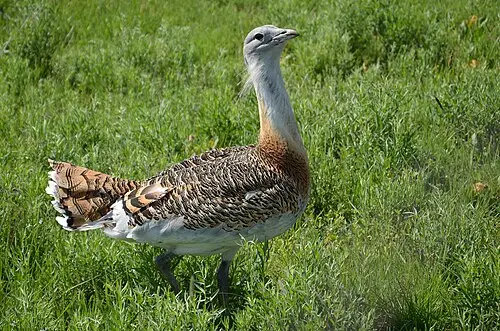
 📸 Photo
Photo: Pasztilla aka Attila Terbócs · CC BY-SA 4.0 · Wikimedia Commons Source
Great Bustard
Otis tarda (Great Bustard · ノガン)
🇰🇷 Class I endangered wildlife (Korea) · Natural Monument (Korea) «Great Bustard»
💡 Everyday Comparisons for Size, Mass & Speed
- 💡 Before the Korean War, it was a commonly seen winter visitor and a representative game bird (Encyclopedia of Korean Culture).
- 💡 Its weight of 8.1 kg recorded by the BTO is slightly lighter than a 10 kg bag of rice (Comparison).
Reference standards: coach bus ~12 m, mid-size car ~4.9 m, compact car ~1 t, basketball hoop 3.05 m, credit card 8.56 cm.
Site-computed relative index from recorded values; not a formal scientific metric.
📖 1. Overview
The Great Bustard, also called 'deul-chilmyeonjo' (wild turkey) in Korean, is a large bird with a fragmented distribution from Spain to East Asia. Males are much larger than females, with a body length of about 102 cm in males and about 76 cm in females.
🦴 2. Anatomy & Morphology
Males are dark brown from the hindneck to the breast with a chestnut breast band and whisker-like feathers from the throat to the chin. Females are gray without a breast band, and the bill is yellowish-brown.
🔍 3. Ecology & Behavior
It nests in wide plains, farmlands, and short-grass meadows, laying 2–3 eggs that the female incubates for 25–28 days. It is a very wary bird.
🇰🇷 4. Connection to Korea
It is Class I endangered wildlife (Korea), and records from the Korea Heritage Service note that it was designated as a Natural Monument (Korea) in 1968. Before the Korean War it was a common winter visitor, but it is now rarely seen.
📚 Sources & References
- • IUCN Red List EN (2023) — https://www.iucnredlist.org/species/22691900/226280431
- • 멸종위기 야생생물 Ⅰ급 · 천연기념물 «느시(들칠면조)» — 국가생물종목록(국립생물자원관) ktsn 120000001626 — https://species.nibr.go.kr/home/mainHome.do?cont_link=009&subMenu=009002&contCd=009002&ktsn=120000001626
- • IUCN Red List category EN — latest assessment at iucnredlist.org
- • Korean protection status: Class I endangered wildlife (Korea) · Natural Monument (Korea) «Great Bustard»
- • doi.org — avilist.v2026
- • iucnredlist.org — 226280431
- • 국가생물종목록(국립생물자원관) ktsn 120000001626 — https://species.nibr.go.kr/home/mainHome.do?cont_link=009&subMenu=009002&contCd=009002&ktsn=120000001626
- • heritage.go.kr — culSelectDetail.do
- • wikidata.org — Q171655
- • commons.wikimedia.org — File:Dévaványa, Hungary – Great bustard 01.jpg
- • bto.org — great-bustard
- • encykorea.aks.ac.kr — E0013306
- • genomics.senescence.info — entry.php
- • Silhouette: PhyloPic — Kai Caspar · CC0 1.0 (Related taxon silhouette — Chlamydotis undulata)
Recorded dimensions are widely cited representative estimates from public literature and may vary by study or specimen.