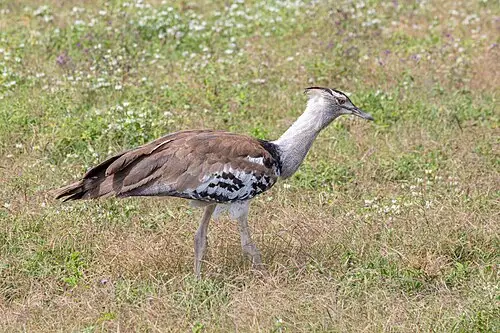
 📸 Photo
Photo: Diego Delso · CC BY-SA 4.0 · Wikimedia Commons Source
Kori Bustard
Ardeotis kori (Kori Bustard · アフリカオオノガン)
💡 Everyday Comparisons for Size, Mass & Speed
- 💡 Its maximum weight of 19 kg is close to two 10 kg bags of rice, and its height of 1.5 m is similar to an upper-grade elementary school child.
- 💡 Because of its impressive size and elaborate courtship dance, it draws wildlife tourists in several African countries, though it is also hunted for meat in some regions (Animal Diversity Web).
Reference standards: coach bus ~12 m, mid-size car ~4.9 m, compact car ~1 t, basketball hoop 3.05 m, credit card 8.56 cm.
Site-computed relative index from recorded values; not a formal scientific metric.
📖 1. Overview
The Kori Bustard is among the heaviest flying birds, inhabiting open grasslands and lightly wooded savannas of eastern and southern Africa.
🦴 2. Anatomy & Morphology
It has a thick neck, a short crest on the head, a greyish-brown back, and black-and-white patterning on the shoulders and sides of the neck. It lacks a hind toe and has short, broad toes suited for walking and running.
🔍 3. Ecology & Behavior
An omnivore that eats insects, lizards, small rodents, seeds, fruits, and even carrion, it prefers walking to flying. Displaying males inflate the esophagus up to four times its normal size, fan the tail, and emit deep booming calls.
🇰🇷 4. Connection to Korea
No direct record connecting this species to Korea has been found.
📚 Sources & References
- • IUCN Red List NT (2025) — https://www.iucnredlist.org/species/22691928/246077557
- • IUCN Red List category NT — latest assessment at iucnredlist.org
- • doi.org — avilist.v2026
- • iucnredlist.org — 246077557
- • wikidata.org — Q686287
- • commons.wikimedia.org — File:Avutarda kori (Ardeotis kori), zona de conservación de
- • animaldiversity.org — Ardeotis kori
- • nationalzoo.si.edu — kori-bustard
- • Silhouette: PhyloPic — author not recorded · CC0 1.0
Recorded dimensions are widely cited representative estimates from public literature and may vary by study or specimen.