 📸 Photo
Photo: Munkel · Public domain · Wikimedia Commons Source
Cuban Treefrog
Osteopilus septentrionalis (Cuban Treefrog · キューバズツキガエル)
💡 Everyday Comparisons for Size, Mass & Speed
- 💡 Its average weight of 57 g is about that of seven Korean 500-won coins (7.7 g) (Comparison).
- 💡 In suburban southern Florida, it is frequently found around buildings and even inside houses (ADW).
Reference standards: coach bus ~12 m, mid-size car ~4.9 m, compact car ~1 t, basketball hoop 3.05 m, credit card 8.56 cm.
Site-computed relative index from recorded values; not a formal scientific metric.
📖 1. Overview
The Cuban Treefrog is among the largest treefrogs found in Florida and thrives in urban and suburban settings such as around buildings.
🦴 2. Anatomy & Morphology
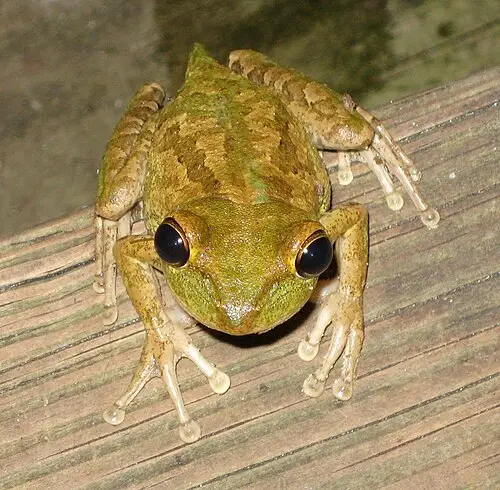
Its body length is 2.5–12 cm, with females sometimes nearly twice the size of males, and its average weight is 57 g. It has bulging eyes and wide adhesive pads at the tips of its toes for climbing, while its body is mostly white to light brown with a white, rough belly.
🔍 3. Ecology & Behavior
An ambush predator, it eats not only beetles and cockroaches but also other frogs, lizards, and snakes; tadpoles mainly eat algae but also cannibalize one another. Males call in loud choruses after rain to attract mates, and when caught the frog inflates its body and releases defensive secretions.
🇰🇷 4. Connection to Korea
No direct record connecting this species to Korea has been found.
📚 Sources & References
- • IUCN Red List LC (2021) — https://www.iucnredlist.org/species/55811/3032751
- • IUCN Red List category LC — latest assessment at iucnredlist.org
- • catalogueoflife.org — 6TBCV
- • iucnredlist.org — 3032751
- • wikidata.org — Q1790867
- • commons.wikimedia.org — File:Osteopilus septentrionalis 6.jpg
- • animaldiversity.org — Osteopilus septentrionalis
- • bok.or.kr — contents.do
- • Silhouette: PhyloPic — Caleb M. Gordon · CC0 1.0
Recorded dimensions are widely cited representative estimates from public literature and may vary by study or specimen.