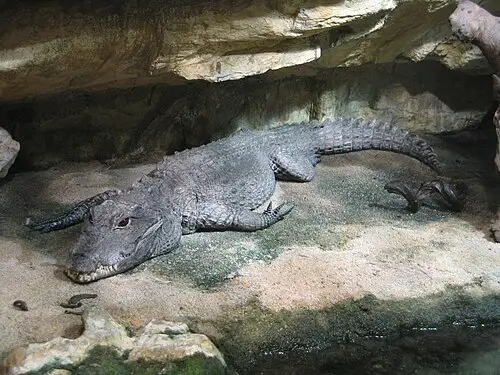
 📸 Photo
Photo: Thesupermat · CC BY-SA 3.0 · Wikimedia Commons Source
Dwarf Crocodile
Osteolaemus tetraspis (Dwarf Crocodile · ニシアフリカコビトワニ)
💡 Everyday Comparisons for Size, Mass & Speed
- 💡 A maximum length of 1.8 m is similar to an adult human's height, and a male's maximum weight of 45.4 kg is just over two 20 kg bags of rice (Comparison).
- 💡 In month 11 of 2017, eight West African Dwarf Crocodiles hatched at the San Diego Zoo reptile house, marking a first in the zoo's history (San Diego Zoo Wildlife Alliance).
Reference standards: coach bus ~12 m, mid-size car ~4.9 m, compact car ~1 t, basketball hoop 3.05 m, credit card 8.56 cm.
Site-computed relative index from recorded values; not a formal scientific metric.
📖 1. Overview
The Dwarf Crocodile is the smallest crocodile, living in small rivers, pools, and swamps inside forests of West and Central Africa. Its IUCN assessment is Vulnerable (VU) as of 1996.
🦴 2. Anatomy & Morphology
Its body length is 1–1.8 m, and the tail makes up 40–50% of the total length. There is no marked length difference between males and females, though males are heavier and become stocky and broad.
🔍 3. Ecology & Behavior
An opportunistic predator that hunts at night, it eats millipedes, beetle larvae, fish, crabs, shrimp, reptiles, amphibians, birds, and small mammals. As the most terrestrial crocodile, it searches for food along forest trails and builds mound nests of fallen leaves and rotting vegetation to lay about 10–14 eggs.
🇰🇷 4. Connection to Korea
No direct record connecting this species to Korea has been found.
📚 Sources & References
- • IUCN Red List VU (1996) — https://www.iucnredlist.org/species/15635/4931429
- • IUCN Red List category VU — latest assessment at iucnredlist.org
- • catalogueoflife.org — 6TBCB
- • iucnredlist.org — 4931429
- • wikidata.org — Q244349
- • commons.wikimedia.org — File:Crocodile nain aquarium porte dorée Paris.JPG
- • ielc.libguides.com — dwarf crocodile
- • Silhouette: PhyloPic — Matthew Speight · CC0 1.0 (Related taxon silhouette — Crocodylus suchus)
Recorded dimensions are widely cited representative estimates from public literature and may vary by study or specimen.