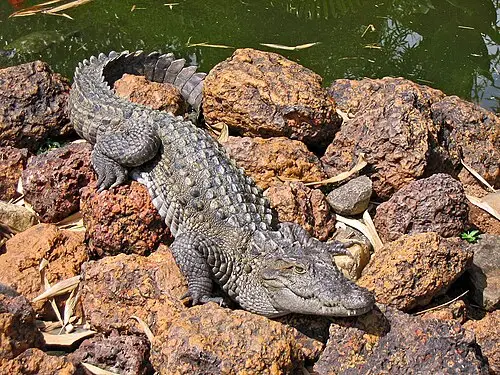
 📸 Photo
Photo: Karunakar Rayker from India · CC BY-SA 2.0 · Wikimedia Commons Source
Mugger Crocodile
Crocodylus palustris (Mugger Crocodile · ヌマワニ)
💡 Everyday Comparisons for Size, Mass & Speed
- 💡 Its maximum length of 5 m is slightly longer than a passenger car (about 4.5 m), and its maximum mass of 700 kg equals the weight of 35 bags of rice weighing 20 kg each (Comparison).
- 💡 Once hunted for its hide, hunting has declined since the 1930s following laws prohibiting the hunting of endangered species (benefit to humans noted by ADW).
Reference standards: coach bus ~12 m, mid-size car ~4.9 m, compact car ~1 t, basketball hoop 3.05 m, credit card 8.56 cm.
Site-computed relative index from recorded values; not a formal scientific metric.
📖 1. Overview
The Mugger Crocodile is the crocodile most commonly seen in freshwater habitats such as rivers, lakes, and village ponds in South Asia. Its IUCN status is Vulnerable (VU) as of 2013.
🦴 2. Anatomy & Morphology
Its entire body is covered in rough, thick, muddy-brown scales, and it has the broadest snout of any crocodile. Females are smaller than males, and hatchlings measure 0.27 m long and weigh less than 0.3 kg.
🔍 3. Ecology & Behavior
An opportunistic carnivore that eats any animal smaller than itself, including other crocodiles, it waits at the water's edge to catch birds or bats and eats 10–25% of its body weight in a single meal. When temperatures drop below 5°C or exceed 38°C, it retreats into burrows dug in the ground.
🇰🇷 4. Connection to Korea
No direct record connecting this species to Korea has been found.
📚 Sources & References
- • IUCN Red List VU (2013) — https://www.iucnredlist.org/species/5667/3046723
- • IUCN Red List category VU — latest assessment at iucnredlist.org
- • catalogueoflife.org — ZKNN
- • iucnredlist.org — 3046723
- • wikidata.org — Q81207
- • commons.wikimedia.org — File:Marsh crocodile - Basking in the sun.jpg
- • animaldiversity.org — Crocodylus palustris
- • Silhouette: PhyloPic — Becky Barnes · CC0 1.0 (Congeneric silhouette — Crocodylus)
Recorded dimensions are widely cited representative estimates from public literature and may vary by study or specimen.