 📸 Photo
Photo: Daderot · CC0 · Wikimedia Commons Source
Red flower crab
Orisarma intermedium (Red flower crab · ベンケイガニ)
Not Evaluated (NE) on the IUCN Red List yet.
💡 Everyday Comparisons for Size, Mass & Speed
- 💡 A carapace width of about 3.5 cm is nearly 1 cm wider than the diameter of a Korean 500-won coin (about 2.65 cm) (Comparison).
- 💡 The National Institute of Ecology notes that this crab is easily confused with Doduk-ge (a Korean crab name) because of its similar habitat, carapace shape, and claw color. Even if you see a red-clawed crab on stone walls or grass along a lower stream, it may be a protected species that should not be caught.
Reference standards: coach bus ~12 m, mid-size car ~4.9 m, compact car ~1 t, basketball hoop 3.05 m, credit card 8.56 cm.
📖 1. Overview
The red flower crab is a medium-sized crab living in the lower reaches of streams along the southwestern coast and Jeju Island, and is designated as a Class II endangered wildlife species in Korea.
🦴 2. Anatomy & Morphology
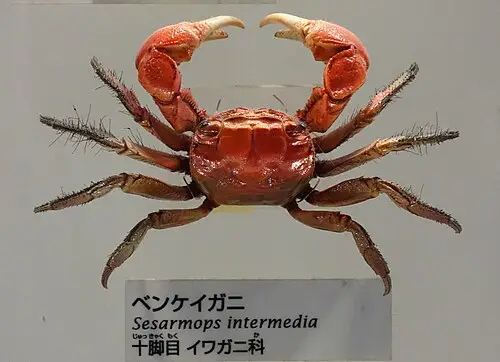
Its carapace is about 3 cm long and about 3.5 cm wide, convex on top with distinct grooves dividing its regions. The claws and frontal area are bright red with very pale yellowish-white tips, and some individuals are red all over.
🔍 3. Ecology & Behavior
It is omnivorous, eating insects, dead fish, and fallen leaves. It mates in May–June, egg-bearing females are seen in June–July, and it comes down to shallow sea waters only during the spawning season. Habitat damage from estuary development is its main threat.
🇰🇷 4. Connection to Korea
The National Institute of Ecology introduces this species as a Class II endangered wildlife species (Korea), distributed along the southwestern coast in Incheon, Chungcheongnam-do, Gyeongsangnam-do, and Jeollanam-do as well as Jeju Island.
📚 Sources & References
- • IUCN Red List: not evaluated (NE) — cross-checked with the Wikidata conservation-status entry
- • marinespecies.org — aphia.php
- • wikidata.org — Q124955963
- • commons.wikimedia.org — File:Sesarmops intermedius - National Museum of Nature and S
- • nie.re.kr — view.do
Recorded dimensions are widely cited representative estimates from public literature and may vary by study or specimen.