 📸 Photo
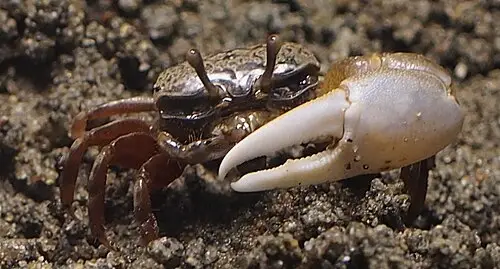
Photo: harum.koh from Kobe city, Japan · CC BY-SA 2.0 · Wikimedia Commons Source
Milky fiddler crab
Austruca lactea (Milky fiddler crab · ハクセンシオマネキ)
Not Evaluated (NE) on the IUCN Red List yet.
🇰🇷 Class II endangered wildlife (Korea)
💡 Everyday Comparisons for Size, Mass & Speed
- 💡 Its carapace length of 9 mm is about 1/3 the diameter of a 500-won coin (26.5 mm).
- 💡 The large claw is more than 2 times the carapace width (about 14 mm)—exceeding 28 mm, which can make it longer than the diameter of a 500-won coin.
- 💡 Because reclamation and development projects on tidal flats are the main threats reducing its habitat, this species is directly linked to how we use tidal flats.
Reference standards: coach bus ~12 m, mid-size car ~4.9 m, compact car ~1 t, basketball hoop 3.05 m, credit card 8.56 cm.
📖 1. Overview
The milky fiddler crab (Austruca lactea) is a small crab living on tidal flats along the southwestern coast of Korea; males have one much larger claw that is white.
🦴 2. Anatomy & Morphology
Its carapace is trapezoidal, wide in front and narrow in back, with dark bluish markings on a gray back. In males, one cheliped (claw) is more than 2 times the width of the carapace, whereas in females the claws are small and equal on both sides.
🔍 3. Ecology & Behavior
It digs vertical burrows in sandy mud in the upper intertidal zone and feeds on organic matter in the mud. It breeds around June to July, and females choose mates based on the size and waving motion of the male's large claw.
🇰🇷 4. Connection to Korea
In Korea, it is a Class II Endangered Wildlife species distributed across tidal flats on the southwestern coast. Reduction and fragmentation of habitat due to tidal flat development are its greatest threats.
📚 Sources & References
- • 멸종위기 야생생물 Ⅱ급 — 국가생물종목록(국립생물자원관) ktsn 120000224289 — https://species.nibr.go.kr/home/mainHome.do?cont_link=009&subMenu=009002&contCd=009002&ktsn=120000224289
- • IUCN Red List: not evaluated (NE) — cross-checked with the Wikidata conservation-status entry
- • Korean protection status: Class II endangered wildlife (Korea)
- • marinespecies.org — aphia.php
- • 국가생물종목록(국립생물자원관) ktsn 120000224289 — https://species.nibr.go.kr/home/mainHome.do?cont_link=009&subMenu=009002&contCd=009002&ktsn=120000224289
- • wikidata.org — Q63724496
- • commons.wikimedia.org — File:Milky Fiddler Crab (Uca lactea) (15875959960) (cropped)
- • nie.re.kr — view.do
- • species.nibr.go.kr — general-search
- • Silhouette: PhyloPic — Loran Honório da Silva · CC BY 4.0 (Related taxon silhouette — Ocypode quadrata)
Recorded dimensions are widely cited representative estimates from public literature and may vary by study or specimen.