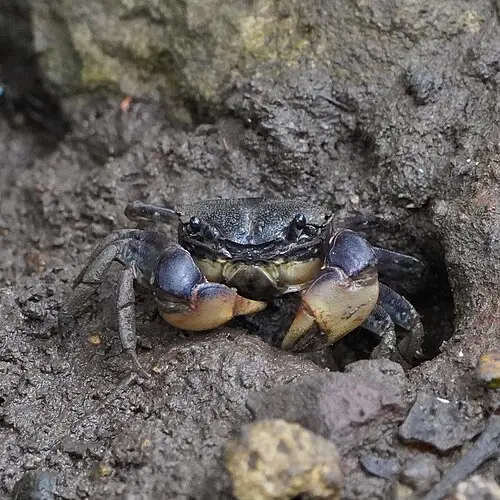
 📸 Photo
Photo: TheMaskedLapwing · CC BY-SA 4.0 · Wikimedia Commons Source
Purple and cream shore crab
Pseudohelice subquadrata (Purple and cream shore crab · Purple and cream shore crab)
Not Evaluated (NE) on the IUCN Red List yet.
🇰🇷 Class I endangered wildlife (Korea)
💡 Everyday Comparisons for Size, Mass & Speed
- 💡 A width of 2 cm is smaller than the diameter of a Korean 500-won coin (26.5 mm) (Comparison).
- 💡 A width of 2 cm is about 1/10 the short side of an A4 sheet of paper (21 cm) (Comparison).
- 💡 The greatest threat to this crab is the loss of its habitat as coastal grasslands and tidal flats are developed.
Reference standards: coach bus ~12 m, mid-size car ~4.9 m, compact car ~1 t, basketball hoop 3.05 m, credit card 8.56 cm.
📖 1. Overview
The purple and cream shore crab is a small crab that burrows in grassy areas above tidal flats, widely distributed near warm seas including Japan, Taiwan, Australia, and East Africa.
🦴 2. Anatomy & Morphology
Its carapace is squarish, purplish brown with cream-colored mottling on the back, and the front is short and tongue-shaped. Its two chelipeds are equal on left and right, short and stout, and densely covered with small granules.
🔍 3. Ecology & Behavior
It mainly feeds on the carcasses of various organisms and organic matter, and is presumed to mate from May to July.
🇰🇷 4. Connection to Korea
In Korea, it is a Class I endangered wildlife species (Korea) and lives in parts of Jeollanam-do as well as Geomundo, Jeju Island, and Udo. Its small habitat area and coastal development are known as the main threats causing its population decline.
📚 Sources & References
- • 멸종위기 야생생물 Ⅰ급 — 국가생물종목록(국립생물자원관) ktsn 120000048894 — https://species.nibr.go.kr/home/mainHome.do?cont_link=009&subMenu=009002&contCd=009002&ktsn=120000048894
- • IUCN Red List: not evaluated (NE) — cross-checked with the Wikidata conservation-status entry
- • Korean protection status: Class I endangered wildlife (Korea)
- • marinespecies.org — aphia.php
- • 국가생물종목록(국립생물자원관) ktsn 120000048894 — https://species.nibr.go.kr/home/mainHome.do?cont_link=009&subMenu=009002&contCd=009002&ktsn=120000048894
- • wikidata.org — Q14191748
- • commons.wikimedia.org — File:Pseudohelice subquadrata, Port Macquarie, NSW, Australi
- • nie.re.kr — view.do
- • species.nibr.go.kr — general-search
- • Silhouette: PhyloPic — Polina Drozdova · CC0 1.0 (Related taxon silhouette — Eriocheir sinensis)
Recorded dimensions are widely cited representative estimates from public literature and may vary by study or specimen.