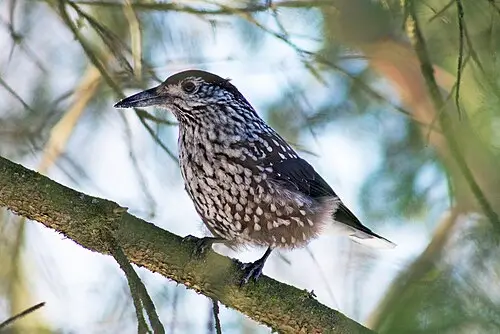
 📸 Photo
Photo: Jyrki Salmi from Finland · CC BY-SA 2.0 · Wikimedia Commons Source
Northern Nutcracker
Nucifraga caryocatactes (Northern Nutcracker · ホシガラス)
💡 Everyday Comparisons for Size, Mass & Speed
- 💡 Just like 'jat' (pine nut) in its Korean name, it loves eating seeds of conifers such as pines (National List of Species of Korea).
- 💡 Its body length of 34.5 cm is slightly longer than a 30 cm ruler (Comparison).
Reference standards: coach bus ~12 m, mid-size car ~4.9 m, compact car ~1 t, basketball hoop 3.05 m, credit card 8.56 cm.
📖 1. Overview
The Northern Nutcracker is a corvid much smaller than a crow, an uncommon-to-common resident bird breeding throughout the Korean Peninsula that loves pine seeds.
🦴 2. Anatomy & Morphology
The head and hindneck are dark chocolate brown, and the ear coverts and throat have droplet-shaped white spots. The wings are blackish-brown with an indigo-green gloss, and the bill is black with white rictal bristles.
🔍 3. Ecology & Behavior
It breeds mainly in highlands and wanders to lowlands in winter, living in small flocks, alone, or in pairs. It forages in trees or on the ground, favors conifer seeds such as pine seeds, and breeds once a year, laying 2–5 eggs per clutch.
🇰🇷 4. Connection to Korea
According to the National List of Species of Korea, it is a not-uncommon resident bird breeding across the Korean Peninsula.
📚 Sources & References
- • IUCN Red List LC (2024) — https://www.iucnredlist.org/species/103727252/264568782
- • IUCN Red List category LC — latest assessment at iucnredlist.org
- • doi.org — avilist.v2026
- • iucnredlist.org — 264568782
- • 국가생물종목록(국립생물자원관) ktsn 120000001960 — https://species.nibr.go.kr/home/mainHome.do?cont_link=009&subMenu=009002&contCd=009002&ktsn=120000001960
- • wikidata.org — Q184820
- • commons.wikimedia.org — File:Nucifraga caryocatactes, Kotka, Finland 1.jpg
- • species.nibr.go.kr — mainHome.do
- • Silhouette: PhyloPic — Joshua Fowler · CC0 1.0 (Congeneric silhouette — Nucifraga columbiana)
Recorded dimensions are widely cited representative estimates from public literature and may vary by study or specimen.