 📸 Photo
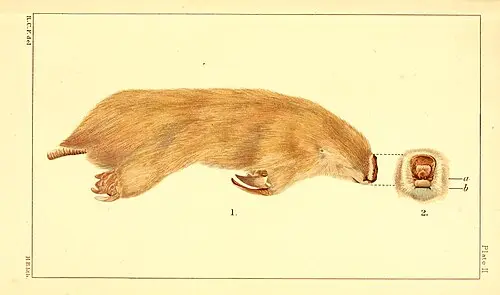
Photo: Drawing: Rosa Catherine Fiveash (1854-1938) Lithograph: Harcourt Barrett (1838–1904), for the South Australian Government Printing Office · Public domain · Wikimedia Commons Source
Central Desert Marsupial Mole
Notoryctes typhlops (Central Desert Marsupial Mole · フクロモグラ)
💡 Everyday Comparisons for Size, Mass & Speed
- 💡 A total length of 14.5 cm is slightly longer than a ballpoint pen, and a weight of 60 g is similar to a chicken egg (Comparison).
- 💡 Its pelts were once traded for high prices, though rarely today, and because it lives in remote areas it seldom encounters people.
Reference standards: coach bus ~12 m, mid-size car ~4.9 m, compact car ~1 t, basketball hoop 3.05 m, credit card 8.56 cm.
Site-computed relative index from recorded values; not a formal scientific metric.
📖 1. Overview
The Central Desert Marsupial Mole is a small, blind marsupial that burrows through desert sands. Because sightings are rare, little is known about its life.
🦴 2. Anatomy & Morphology
It lacks eyes, optic nerves, and external ears, retaining only tiny black eye vestiges beneath the skin. Its short, silky fur varies regionally from creamy white to reddish brown.
🔍 3. Ecology & Behavior
It prefers ants and ant eggs and occasionally eats termites, larvae, and small reptiles. Digging with its forefeet and pushing sand backward with its hind limbs and tail, it mostly burrows 20–100 cm underground.
🇰🇷 4. Connection to Korea
No direct record connecting this species to Korea has been found.
📚 Sources & References
- • IUCN Red List LC (2016) — https://www.iucnredlist.org/species/14879/21965004
- • IUCN Red List category LC — latest assessment at iucnredlist.org
- • mammaldiversity.org — 1000142
- • iucnredlist.org — 21965004
- • wikidata.org — Q209750
- • commons.wikimedia.org — File:Notoryctes typhlops.jpg
- • animaldiversity.org — Notoryctes typhlops
- • Silhouette: PhyloPic — Sarah Werning · CC BY 3.0
Recorded dimensions are widely cited representative estimates from public literature and may vary by study or specimen.