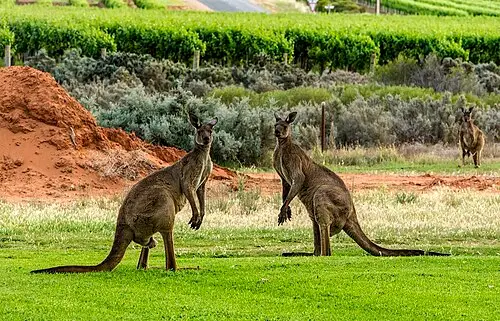
 📸 Photo
Photo: Sheba_Also 43,000 photos · CC BY-SA 2.0 · Wikimedia Commons Source
Western Gray Kangaroo
Macropus fuliginosus (Western Gray Kangaroo · クロカンガルー)
💡 Everyday Comparisons for Size, Mass & Speed
- 💡 Its maximum weight of 53.5 kg equals 2–3 bags of 20 kg rice, and its standing height of up to about 2.1 m is similar to the height of an indoor door (about 2 m) (Comparison).
- 💡 Tourists watch this kangaroo on golf courses and in national parks, and Australian kangaroo meat is sold worldwide as quality game meat.
Reference standards: coach bus ~12 m, mid-size car ~4.9 m, compact car ~1 t, basketball hoop 3.05 m, credit card 8.56 cm.
Site-computed relative index from recorded values; not a formal scientific metric.
📖 1. Overview
The Western Gray Kangaroo is a large kangaroo living in southern Australia, adapting to habitats ranging from woodlands, coastal heathlands, and grasslands to golf courses.
🦴 2. Anatomy & Morphology
Its coat varies from pale brown to dark reddish-brown with a paler throat, chest, and belly. Its muzzle is covered in finer hair than in other kangaroos, and muscle makes up about 80% of its body weight.
🔍 3. Ecology & Behavior
It feeds on fibrous plants such as grasses, leaves, bark, and shrubs, digesting them with microorganisms in its cecum. It spends 6–10 hours a day grazing, needs very little water, and forms family groups centered on adult females.
🇰🇷 4. Connection to Korea
No direct record connecting this species to Korea has been found.
📚 Sources & References
- • IUCN Red List LC (2016) — https://www.iucnredlist.org/species/40563/21953972
- • IUCN Red List category LC — latest assessment at iucnredlist.org
- • mammaldiversity.org — 1000276
- • iucnredlist.org — 21953972
- • wikidata.org — Q510022
- • commons.wikimedia.org — File:Bramera Cemetery Kangaroos-1 (14987013563).jpg
- • animaldiversity.org — Macropus fuliginosus
- • Silhouette: PhyloPic — Rachel T Mason · CC0 1.0
Recorded dimensions are widely cited representative estimates from public literature and may vary by study or specimen.