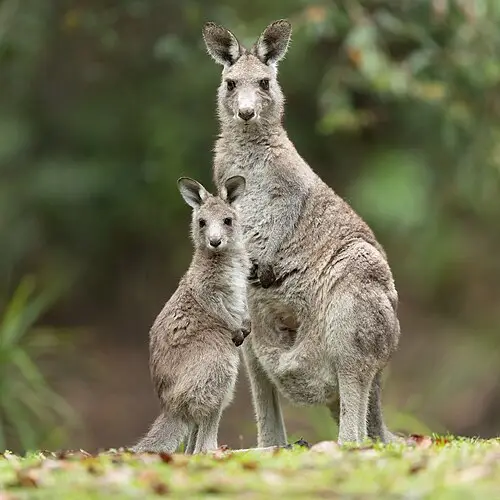
 📸 Photo
Photo: JJ Harrison ( https://www.jjharrison.com.au/ ) · CC BY-SA 4.0 · Wikimedia Commons Source
Eastern Gray Kangaroo
Macropus giganteus (Eastern Gray Kangaroo · オオカンガルー)
💡 Everyday Comparisons for Size, Mass & Speed
- 💡 Its maximum weight of 90 kg equals 4–5 bags of 20 kg rice, and its speed of 30 mph (about 48 km/h) is close to a 50 km/h city road speed limit (Comparison).
- 💡 Aboriginal Australians and European settlers have hunted it for food, and today a sizable kangaroo industry harvests it within government quotas.
Reference standards: coach bus ~12 m, mid-size car ~4.9 m, compact car ~1 t, basketball hoop 3.05 m, credit card 8.56 cm.
Site-computed relative index from recorded values; not a formal scientific metric.
📖 1. Overview
The Eastern Gray Kangaroo is a large kangaroo living in eastern Australia, ranging widely from open woodlands and grasslands to forested mountains. Though similar to the Western Gray Kangaroo, its coat color is more uniform and its face is whitish.
🦴 2. Anatomy & Morphology
Males weigh 2–3 times as much as females. Unlike the Western Gray Kangaroo, it lacks a white patch on the thigh.
🔍 3. Ecology & Behavior
A herbivore that feeds mainly on grasses along with various herbs and leaves, it grazes from dusk until dawn. It usually lives in social groups called 'mobs' and covers about 9 m in a single hop.
🇰🇷 4. Connection to Korea
No direct record connecting this species to Korea has been found.
📚 Sources & References
- • IUCN Red List LC (2016) — https://www.iucnredlist.org/species/41513/21952954
- • IUCN Red List category LC — latest assessment at iucnredlist.org
- • mammaldiversity.org — 1000277
- • iucnredlist.org — 21952954
- • wikidata.org — Q270098
- • commons.wikimedia.org — File:Macropus giganteus - Brunkerville.jpg
- • animaldiversity.org — Macropus giganteus
- • Silhouette: PhyloPic — Natalie Kestel · CC BY 4.0
Recorded dimensions are widely cited representative estimates from public literature and may vary by study or specimen.