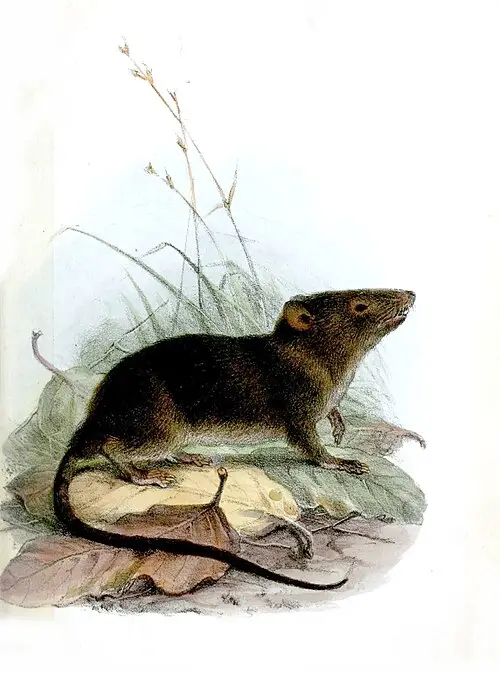
 📸 Photo
Photo: Joseph Wolf ? · Public domain · Wikimedia Commons Source
Dusky Shrew-opossum
Caenolestes fuliginosus (Dusky Shrew-opossum · エクアドルケノレステス)
💡 Everyday Comparisons for Size, Mass & Speed
- 💡 Its total length of 23.7 cm including the tail is slightly longer than the short side of an A4 sheet of paper (21 cm), and its weight of 39 g is lighter than a chicken egg (about 60 g) (Comparison).
- 💡 Because it lives high in hard-to-reach mountains, it rarely encounters humans and has no known human uses, making it an animal in need of further study.
Reference standards: coach bus ~12 m, mid-size car ~4.9 m, compact car ~1 t, basketball hoop 3.05 m, credit card 8.56 cm.
Site-computed relative index from recorded values; not a formal scientific metric.
📖 1. Overview
The dusky shrew-opossum is a small marsupial with a pointed, shrew-like face that lives on cool, moist high mountains. Despite being called an opossum, females lack a pouch.
🦴 2. Anatomy & Morphology
Its coat is glossy dark brown or gray and very silky. Compared with other species in its genus, it has a more delicate build and a fragile skull, and its semi-prehensile tail helps when climbing.
🔍 3. Ecology & Behavior
It feeds mainly on invertebrates such as insects, spiders, and earthworms, along with small vertebrates and plant matter. It spends the day in burrows under tree roots and forages among moss and leaf litter in the evening and at night.
🇰🇷 4. Connection to Korea
No direct record connecting this species to Korea has been found.
📚 Sources & References
- • IUCN Red List LC (2016) — https://www.iucnredlist.org/species/41506/22179949
- • IUCN Red List category LC — latest assessment at iucnredlist.org
- • mammaldiversity.org — 1000009
- • iucnredlist.org — 22179949
- • wikidata.org — Q194426
- • commons.wikimedia.org — File:HyracodonFuliginosusWolf.jpg
- • animaldiversity.org — Caenolestes fuliginosus
- • Silhouette: PhyloPic — Sarah Werning · CC BY 3.0
Recorded dimensions are widely cited representative estimates from public literature and may vary by study or specimen.