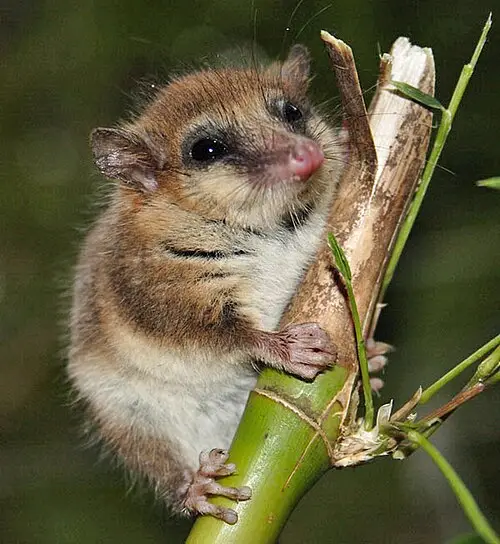
 📸 Photo
Photo: José Luis Bartheld from Valdivia, Chile · CC BY 2.0 · Wikimedia Commons Source
Southern Monito del Monte
Dromiciops gliroides (Southern Monito del Monte · チロエオポッサム)
💡 Everyday Comparisons for Size, Mass & Speed
- 💡 Its maximum weight of 42 g is lighter than one chicken egg (usually 50–60 g) (Comparison).
- 💡 By eating mistletoe fruits and dispersing their seeds, it is closely linked to the plants of southern South American forests.
Reference standards: coach bus ~12 m, mid-size car ~4.9 m, compact car ~1 t, basketball hoop 3.05 m, credit card 8.56 cm.
Site-computed relative index from recorded values; not a formal scientific metric.
📖 1. Overview
The Southern Monito del Monte is a mouse-sized marsupial living in the southern temperate forests of South America, called a 'living fossil' as the last survivor of an ancient lineage.
🦴 2. Anatomy & Morphology
It has distinct black rings around its eyes and a prehensile tail. Females have a thicker tail used to store energy.
🔍 3. Ecology & Behavior
It eats insects such as moths and butterflies and their larvae, along with plenty of fleshy fruits in summer. When the weather is cold and food is scarce, it enters deep hibernation; in the Southern Hemisphere spring (August–September), females give birth to 1–5 young per litter and build arboreal nests out of bamboo branches.
🇰🇷 4. Connection to Korea
No direct record connecting this species to Korea has been found.
📚 Sources & References
- • IUCN Red List NT (2025) — https://www.iucnredlist.org/species/281700363/281700389
- • IUCN Red List category NT — latest assessment at iucnredlist.org
- • mammaldiversity.org — 1000139
- • iucnredlist.org — 281700389
- • wikidata.org — Q691991
- • commons.wikimedia.org — File:Monito del Monte ps6.jpg
- • animaldiversity.org — Dromiciops gliroides
- • Silhouette: PhyloPic — Sarah Werning · CC BY 3.0
Recorded dimensions are widely cited representative estimates from public literature and may vary by study or specimen.