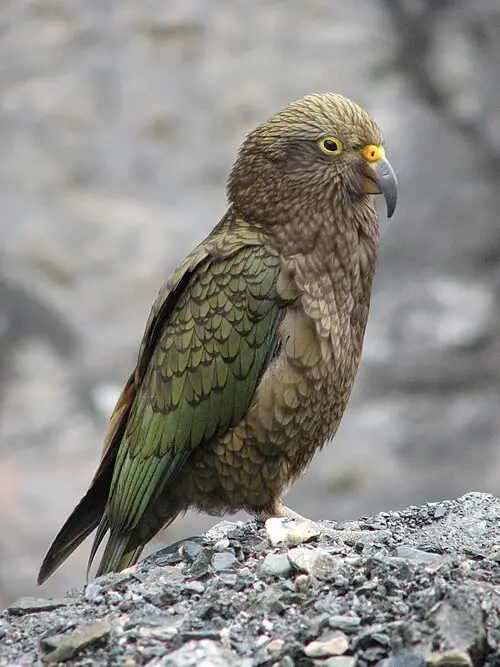
 📸 Photo
Photo: Markus Koljonen ( Dilaudid ) · CC BY-SA 3.0 · Wikimedia Commons Source
Kea
Nestor notabilis (Kea · ミヤマオウム)
💡 Everyday Comparisons for Size, Mass & Speed
- 💡 Its body length of 48 cm is slightly over one and a half sheets of A4 paper along the long side (29.7 cm), and its weight of 922 g is slightly lighter than a 1 L carton of milk (Comparison).
- 💡 Called 'the clown of the Southern Alps' by New Zealand's Department of Conservation, it gathers on cars and attracts tourists, making it an important bird for the tourism industry.
Reference standards: coach bus ~12 m, mid-size car ~4.9 m, compact car ~1 t, basketball hoop 3.05 m, credit card 8.56 cm.
Site-computed relative index from recorded values; not a formal scientific metric.
📖 1. Overview
The Kea is a crow-sized parrot living in the mountains of New Zealand's Southern Alps, known for being highly intelligent and curious. Its IUCN status is Endangered (EN).
🦴 2. Anatomy & Morphology
The head and underparts are brownish-green, the underwings are orange-red with yellow barring, and the outer flight feathers are dull blue. The bill curves downward; females have a shorter, less curved bill and weigh about 20% less than males.
🔍 3. Ecology & Behavior
It is an omnivore that eats beech leaves, buds, and nuts, seasonal berries, nectar, beetle grubs, grasshoppers, and snails. Flocks of 30–40 gather at feeding sites such as garbage dumps; it has a polygynous mating system with a strict hierarchy and lays 2–4 eggs in burrows under rocks or among tree roots.
🇰🇷 4. Connection to Korea
No direct record connecting this species to Korea has been found.
📚 Sources & References
- • IUCN Red List EN (2017) — https://www.iucnredlist.org/species/22684831/119243358
- • IUCN Red List category EN — latest assessment at iucnredlist.org
- • doi.org — avilist.v2026
- • iucnredlist.org — 119243358
- • wikidata.org — Q193337
- • commons.wikimedia.org — File:Kea.jpg
- • animaldiversity.org — Nestor notabilis
- • Silhouette: PhyloPic — Matías Muñoz · CC0 1.0
Recorded dimensions are widely cited representative estimates from public literature and may vary by study or specimen.