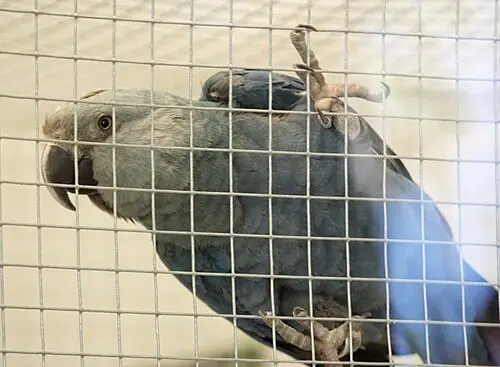
 📸 Photo
Photo: The original uploader was Robert01 at German Wikipedia . ( Original text: Robert01 ) · CC BY-SA 2.0 de · Wikimedia Commons Source
Spix's Macaw
Cyanopsitta spixii (Spix's Macaw · アオコンゴウインコ)
💡 Everyday Comparisons for Size, Mass & Speed
- 💡 Its mass of 360 g is about six chicken eggs (about 60 g each), and its body length of 55 cm is just under two A4 sheets of paper laid along the long side (about 59 cm) (Comparison).
- 💡 Poachers reportedly caught this bird in the wild at almost no cost and sold it for up to 200,000 US dollars, and in some areas it was also hunted for food, reducing its numbers.
Reference standards: coach bus ~12 m, mid-size car ~4.9 m, compact car ~1 t, basketball hoop 3.05 m, credit card 8.56 cm.
Site-computed relative index from recorded values; not a formal scientific metric.
📖 1. Overview
Spix's macaw is a blue parrot that lived in the dry thorn-scrub region of northeastern Brazil, classified by the IUCN in its 2019 assessment as Extinct in the Wild (EW).
🦴 2. Anatomy & Morphology
Its body is dull blue with a faint greenish tinge on the breast and belly and a deeper blue back and tail. Its bare facial skin is dark grey, its eyes are pale yellow, and its bill is smaller and less curved than in close relatives.
🔍 3. Ecology & Behavior
A fruit- and seed-eater, it feeds on seeds of trees such as faveleira and cactus fruits. Highly routine-oriented, it flies the same paths and bathes at the same time each day, pairs for life, and travels along seasonal rivers in pairs or small family groups.
🇰🇷 4. Connection to Korea
No direct record connecting this species to Korea has been found.
📚 Sources & References
- • IUCN Red List EW (2019) — https://www.iucnredlist.org/species/22685533/153022606
- • IUCN Red List category EW — latest assessment at iucnredlist.org
- • doi.org — avilist.v2026
- • iucnredlist.org — 153022606
- • wikidata.org — Q743214
- • commons.wikimedia.org — File:Spixara.jpg
- • animaldiversity.org — Cyanopsitta spixii
- • Silhouette: PhyloPic — Sharon Wegner-Larsen · CC0 1.0
Recorded dimensions are widely cited representative estimates from public literature and may vary by study or specimen.