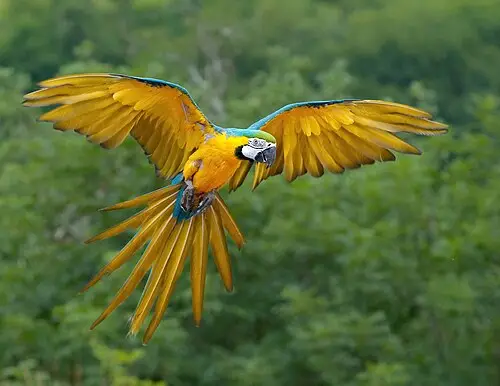
 📸 Photo
Photo: Luc Viatour · CC BY 2.0 · Wikimedia Commons Source
Blue-and-yellow Macaw
Ara ararauna (Blue-and-yellow Macaw · ルリコンゴウインコ)
💡 Everyday Comparisons for Size, Mass & Speed
- 💡 Its vivid plumage and talent for mimicking speech and sounds make it popular as a companion bird (ADW).
- 💡 Poaching from the wild can kill nesting females or destroy hollow nest trees (ADW).
- 💡 At up to 1.8 kg, it weighs slightly more than a 1.5 L bottle of water.
Reference standards: coach bus ~12 m, mid-size car ~4.9 m, compact car ~1 t, basketball hoop 3.05 m, credit card 8.56 cm.
Site-computed relative index from recorded values; not a formal scientific metric.
📖 1. Overview
The Blue-and-yellow Macaw is a large parrot with striking blue upperparts and yellow underparts that inhabits swampy and riparian tropical forests. Pairs bond for life.
🦴 2. Anatomy & Morphology
The back and wings are blue, the underside is yellow, and the forehead is green. The bill, throat, and legs are black, the bare white face is lined with small black feathers, and the powerful bill cracks hard nut shells.
🔍 3. Ecology & Behavior
It feeds on seeds, nuts, and fruits, and visits riverside clay licks, which is thought to neutralize toxins in unripe seeds. It nests high in trees, laying 2–3 eggs per clutch and incubating them for 24–28 days.
🇰🇷 4. Connection to Korea
No direct record connecting this species to Korea has been found.
📚 Sources & References
- • IUCN Red List LC (2018) — https://www.iucnredlist.org/species/22685539/131917270
- • IUCN Red List category LC — latest assessment at iucnredlist.org
- • doi.org — avilist.v2026
- • iucnredlist.org — 131917270
- • wikidata.org — Q205477
- • commons.wikimedia.org — File:Ara ararauna Luc Viatour.jpg
- • animaldiversity.org — Ara ararauna
- • Silhouette: PhyloPic — Edwin Price · CC BY 4.0
Recorded dimensions are widely cited representative estimates from public literature and may vary by study or specimen.