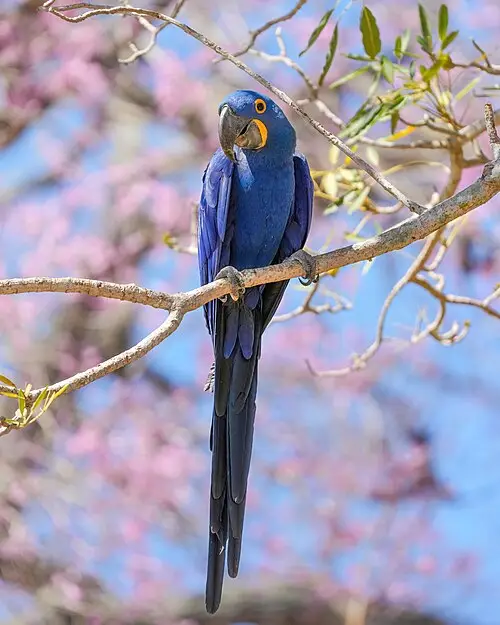
 📸 Photo
Photo: Giles Laurent · CC BY-SA 4.0 · Wikimedia Commons Source
Hyacinth Macaw
Anodorhynchus hyacinthinus (Hyacinth Macaw · スミレコンゴウインコ)
💡 Everyday Comparisons for Size, Mass & Speed
- 💡 Its body length of about 1 m is about three and a half sheets of A4 paper along the long side (29.7 cm), and its weight of 1.7 kg is slightly heavier than a 1.5 L bottle of water (Comparison).
- 💡 In Brazil, tourism to see this bird has become an industry of its own. Meanwhile, capturing wild birds for the international pet trade (illegal in Brazil) has sharply reduced its numbers.
Reference standards: coach bus ~12 m, mid-size car ~4.9 m, compact car ~1 t, basketball hoop 3.05 m, credit card 8.56 cm.
Site-computed relative index from recorded values; not a formal scientific metric.
📖 1. Overview
The Hyacinth Macaw is a blue South American parrot described as the largest of all parrots and lives in semi-open habitats such as the Pantanal wetlands of Brazil.
🦴 2. Anatomy & Morphology
Its entire body is glossy deep ultramarine blue, with bare yellow skin showing only around the eyes and at the base of the lower mandible. Its bill is massive, black, and hooked.
🔍 3. Ecology & Behavior
It feeds mainly on palm nuts of about eight species, filing the hard shell thin with its bill before cracking it cleanly in half. Flying in groups of 2–8 to and from feeding grounds, it pairs for life and lays 1–2 eggs per clutch.
🇰🇷 4. Connection to Korea
No direct record connecting this species to Korea has been found.
📚 Sources & References
- • IUCN Red List VU (2025) — https://www.iucnredlist.org/species/22685516/202613596
- • IUCN Red List category VU — latest assessment at iucnredlist.org
- • doi.org — avilist.v2026
- • iucnredlist.org — 202613596
- • wikidata.org — Q463154
- • commons.wikimedia.org — File:104 Hyacinth macaw with Pink Ipê tree in background in
- • animaldiversity.org — Anodorhynchus hyacinthinus
- • Silhouette: PhyloPic — author not recorded · CC0 1.0
Recorded dimensions are widely cited representative estimates from public literature and may vary by study or specimen.