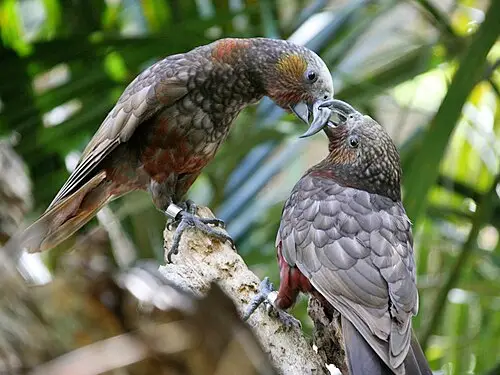
 📸 Photo
Photo: Small · CC BY-SA 2.0 · Wikimedia Commons Source
New Zealand Kaka
Nestor meridionalis (New Zealand Kaka · カカ)
💡 Everyday Comparisons for Size, Mass & Speed
- 💡 Its body length of 44 cm is similar to one and a half sheets of A4 paper along the long side (29.7 cm), and its weight of 400 g is slightly more than six chicken eggs (about 60 g) (Comparison).
- 💡 Although spread across the forests of New Zealand's three main islands, it is uncommon or only occasionally seen, and its varied diet of sap, nectar, and wood-boring larvae links it to many forest plants.
Reference standards: coach bus ~12 m, mid-size car ~4.9 m, compact car ~1 t, basketball hoop 3.05 m, credit card 8.56 cm.
Site-computed relative index from recorded values; not a formal scientific metric.
📖 1. Overview
The New Zealand Kaka is a medium-sized forest parrot of New Zealand and a close relative of the Kea. Its IUCN status is Vulnerable (VU).
🦴 2. Anatomy & Morphology
Males have a longer, deeper upper mandible and a larger head than females.
🔍 3. Ecology & Behavior
It feeds on seeds, fruits, nectar, tree sap, aphid honeydew, and wood-boring insect larvae. It breeds mainly in spring and summer, sometimes raising a second brood that continues into winter.
🇰🇷 4. Connection to Korea
No direct record connecting this species to Korea has been found.
📚 Sources & References
- • IUCN Red List VU (2022) — https://www.iucnredlist.org/species/22684840/216083435
- • IUCN Red List category VU — latest assessment at iucnredlist.org
- • doi.org — avilist.v2026
- • iucnredlist.org — 216083435
- • wikidata.org — Q626289
- • commons.wikimedia.org — File:Kaka-Parrots.jpg
- • nzbirdsonline.org.nz — kaka
- • Silhouette: PhyloPic — Matías Muñoz · CC0 1.0 (Congeneric silhouette — Nestor notabilis)
Recorded dimensions are widely cited representative estimates from public literature and may vary by study or specimen.