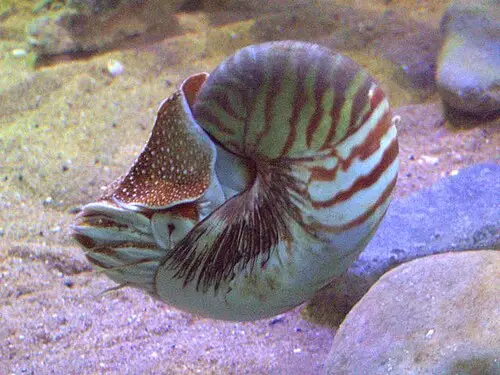
 📸 Photo
Photo: Public domain · Public domain · Wikimedia Commons Source
Chambered nautilus
Nautilus pompilius (Chambered nautilus · Chambered nautilus)
💡 Everyday Comparisons for Size, Mass & Speed
- 💡 Its shells are traded on a large scale; most are shells washed ashore on beaches, and the outer layer is sometimes stripped away to expose the silvery nacre (Australian Museum).
- 💡 It is commonly kept in public aquariums and has been bred successfully in captivity (Australian Museum).
- 💡 Its diameter of 22.2 cm is slightly larger than the short side of an A4 sheet of paper (21 cm), and its weight of 1.7 kg is slightly heavier than a 1.5 L bottle of water (about 1.5 kg) (Comparison).
Reference standards: coach bus ~12 m, mid-size car ~4.9 m, compact car ~1 t, basketball hoop 3.05 m, credit card 8.56 cm.
Site-computed relative index from recorded values; not a formal scientific metric.
📖 1. Overview
The chambered nautilus is a cephalopod with a coiled shell and the most widespread of the 11 living nautilus species. The IUCN Red List assesses it as Vulnerable (VU, 2026).
🦴 2. Anatomy & Morphology
Its shell is divided into about 30 chambers, and a tube passing through the chambers (the siphuncle) regulates gas to keep the body upright and buoyant. Around 90 small suckerless tentacles sit below the head, and its eyes have neither a cornea nor a lens.
🔍 3. Ecology & Behavior
It is a scavenger and opportunistic predator that locates fish and crabs by smell and also eats carrion, feeding mainly on crustaceans. It rests on deep coral reef walls by day and rises to shallower water at night to forage, with a lifespan of up to 20 years.
🇰🇷 4. Connection to Korea
No direct record connecting this species to Korea has been found.
📚 Sources & References
- • IUCN Red List VU (2026) — https://www.iucnredlist.org/species/162636/933767
- • IUCN Red List category VU — latest assessment at iucnredlist.org
- • marinespecies.org — aphia.php
- • iucnredlist.org — 933767
- • wikidata.org — Q872853
- • commons.wikimedia.org — File:Nautilus pompilius.jpg
- • sealifebase.se — Nautilus-pompilius.html
- • australian.museum — nautilus-pompilius
- • animaldiversity.org — Nautilus pompilius
- • Silhouette: PhyloPic — Margot Michaud · CC0 1.0
Recorded dimensions are widely cited representative estimates from public literature and may vary by study or specimen.