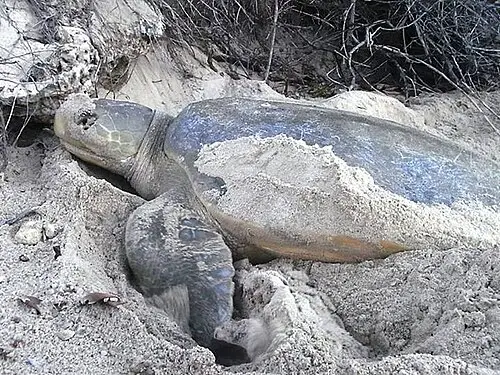
 📸 Photo
Photo: Lyndie Malan · CC BY-SA 3.0 · Wikimedia Commons Source
Flatback Turtle
Natator depressus (Flatback Turtle · ヒラタウミガメ)
💡 Everyday Comparisons for Size, Mass & Speed
- 💡 A maximum length of 96 cm is just over three sheets of A4 paper laid end to end (about 30 cm each), and an average weight of 70 kg is three and a half 20 kg bags of rice (Comparison).
- 💡 Although its eggs were once harvested for food, it is now a subject of research and protection, and nesting sites such as Mon Repos are designated as reserves and serve as ecotourism attractions (positive impacts on humans in ADW).
- 💡 Its meat is rarely sought after by people, which ADW suggests may be because its carnivorous diet makes it taste less appealing than other sea turtles.
Reference standards: coach bus ~12 m, mid-size car ~4.9 m, compact car ~1 t, basketball hoop 3.05 m, credit card 8.56 cm.
Site-computed relative index from recorded values; not a formal scientific metric.
📖 1. Overview
The Flatback Turtle is a medium-sized sea turtle living in Australian coastal waters that prefers shallow, soft-bottomed inshore seas and rarely ventures beyond the continental shelf.
🦴 2. Anatomy & Morphology
As its name suggests, its carapace is smooth and flat with slightly upturned edges. The keratin layer covering its carapace and flippers is thinner than in other sea turtles, so even small pressure can easily cause injury.
🔍 3. Ecology & Behavior
It is a carnivore that eats invertebrates such as sea cucumbers, mollusks, jellyfish, and prawns. Mating and nesting take place in months 11–12; its eggs and hatchlings are large, giving some protection from predators, and hatchlings grow close to shore without entering the open ocean.
🇰🇷 4. Connection to Korea
No direct record connecting this species to Korea has been found.
📚 Sources & References
- • IUCN Red List DD (1996) — https://www.iucnredlist.org/species/14363/210612474
- • IUCN Red List category DD — latest assessment at iucnredlist.org
- • catalogueoflife.org — 45TDR
- • iucnredlist.org — 210612474
- • wikidata.org — Q372997
- • commons.wikimedia.org — File:Natator depressus00.jpg
- • animaldiversity.org — Natator depressus
- • Silhouette: PhyloPic — author not recorded · CC0 1.0
Recorded dimensions are widely cited representative estimates from public literature and may vary by study or specimen.