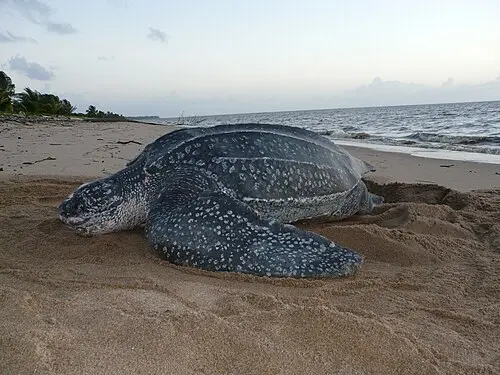
 📸 Photo
Photo: Julien Renoult · CC BY 4.0 · Wikimedia Commons Source
Leatherback Seaturtle
Dermochelys coriacea (Leatherback Seaturtle · オサガメ)
🇰🇷 Marine Protected Species (Korea)
💡 Everyday Comparisons for Size, Mass & Speed
- 💡 A weight of 454 kg equals five and a half traditional sacks of rice (80 kg each) (Comparison).
- 💡 According to NOAA, some Leatherback Seaturtles swim over 10,000 miles (about sixteen thousand km) in 1 year, roughly 40 times the road distance between Seoul and Busan (about 400 km) (Comparison).
- 💡 It is very rare in Korea: of 55 sea turtles washed ashore along Korean coasts from 2015 to 2020, only 2 were Leatherback Seaturtles.
Reference standards: coach bus ~12 m, mid-size car ~4.9 m, compact car ~1 t, basketball hoop 3.05 m, credit card 8.56 cm.
Site-computed relative index from recorded values; not a formal scientific metric.
📖 1. Overview
The Leatherback Seaturtle is a large sea turtle with the widest distribution of any reptile across the Atlantic, Pacific, and Indian Oceans, feeding on jellyfish in the open ocean.
🦴 2. Anatomy & Morphology
Adults measure 5–6 feet (about 1.5–1.8 m) long and weigh 750–1,000 pounds (about 340–454 kg). Inside the mouth are pointed tooth-like projections and backward-pointing spines that hold onto slippery prey.
🔍 3. Ecology & Behavior
It feeds on soft-bodied prey such as jellyfish and salps, diving deeper than any other turtle to about 1,200 m (4,000 feet) and staying underwater for up to 85 minutes. Females come ashore on beaches at night every 2–4 years to lay eggs.
🇰🇷 4. Connection to Korea
In Korea, it is designated as a Marine Protected Species. One individual was confirmed in the waters off Jeju Island from 2013 to 2022, and 2 out of 55 sea turtle strandings in Korea from 2015 to 2020 were Leatherback Seaturtles.
📚 Sources & References
- • IUCN Red List VU (2013) — https://www.iucnredlist.org/species/6494/43526147
- • 해양보호생물 — 국가생물종목록(국립생물자원관) ktsn 120000059450 — https://species.nibr.go.kr/home/mainHome.do?cont_link=009&subMenu=009002&contCd=009002&ktsn=120000059450
- • IUCN Red List category VU — latest assessment at iucnredlist.org
- • Korean protection status: Marine Protected Species (Korea)
- • catalogueoflife.org — 34XB9
- • iucnredlist.org — 43526147
- • 국가생물종목록(국립생물자원관) ktsn 120000059450 — https://species.nibr.go.kr/home/mainHome.do?cont_link=009&subMenu=009002&contCd=009002&ktsn=120000059450
- • wikidata.org — Q120043
- • commons.wikimedia.org — File:Dermochelys coriacea - Julien Renoult - 12981952.jpeg
- • fisheries.noaa.gov — leatherback-turtle
- • species.nibr.go.kr — general-search
- • frontiersin.org — full
- • frontiersin.org — full
- • Silhouette: PhyloPic — James R. Spotila and Ray Chatterji · CC0 1.0
Recorded dimensions are widely cited representative estimates from public literature and may vary by study or specimen.