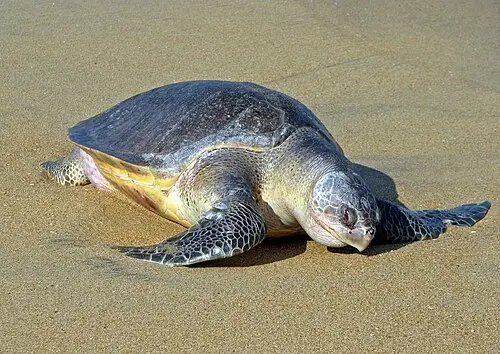
 📸 Photo
Photo: Bernard Gagnon · CC BY-SA 3.0 · Wikimedia Commons Source
Olive Ridley Seaturtle
Lepidochelys olivacea (Olive Ridley Seaturtle · ヒメウミガメ)
💡 Everyday Comparisons for Size, Mass & Speed
- 💡 Its maximum length of 75 cm is about two and a half times the long side of an A4 sheet (about 30 cm), and its maximum mass of 45 kg is slightly more than two 20 kg bags of rice (Comparison).
- 💡 At Ostional Beach in Costa Rica, egg harvesting has been legal since 1987, allowing villagers to sell nearly 3 million eggs per season; only eggs laid during the first 36 hours of a nesting event may be collected (benefit to humans noted by ADW).
- 💡 Because it is known to mistake floating plastic bags and Styrofoam in the sea for food and swallow them, reducing beach litter directly helps protect it (diet description in ADW).
Reference standards: coach bus ~12 m, mid-size car ~4.9 m, compact car ~1 t, basketball hoop 3.05 m, credit card 8.56 cm.
Site-computed relative index from recorded values; not a formal scientific metric.
📖 1. Overview
The Olive Ridley Seaturtle is a sea turtle in the family Cheloniidae that spends most of its time in shallow waters within 15 km of shore, though it is also observed in the open ocean.
🦴 2. Anatomy & Morphology
Its carapace is heart-shaped, olive-colored, and relatively thin compared to other sea turtles. Each of its four flippers bears two claws, and in males the tail extends beyond the carapace.
🔍 3. Ecology & Behavior
Mainly carnivorous, it feeds on invertebrates such as jellyfish, snails, shrimp, and crabs, and often mistakes floating trash such as plastic bags for food and swallows it. Every year it migrates long distances to nesting beaches, with females remembering the scent of their natal beach to return.
🇰🇷 4. Connection to Korea
No direct record connecting this species to Korea has been found.
📚 Sources & References
- • IUCN Red List VU (2008) — https://www.iucnredlist.org/species/11534/3292503
- • IUCN Red List category VU — latest assessment at iucnredlist.org
- • catalogueoflife.org — 3TB2H
- • iucnredlist.org — 3292503
- • wikidata.org — Q282385
- • commons.wikimedia.org — File:Lepidochelys olivacea.jpg
- • animaldiversity.org — Lepidochelys olivacea
- • Silhouette: PhyloPic — author not recorded · CC0 1.0
Recorded dimensions are widely cited representative estimates from public literature and may vary by study or specimen.