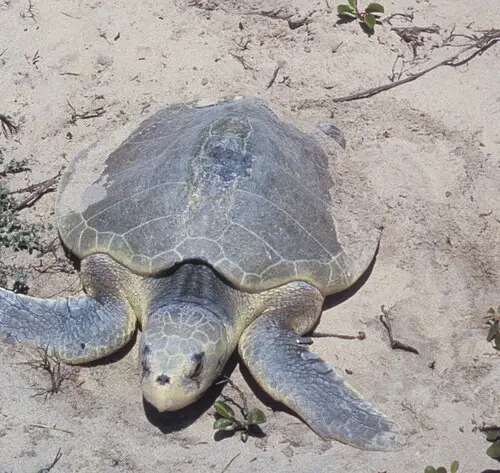
 📸 Photo
Photo: uploaded by Johntex · Public domain · Wikimedia Commons Source
Kemp's Ridley Seaturtle
Lepidochelys kempii (Kemp's Ridley Seaturtle · ケンプヒメウミガメ)
💡 Everyday Comparisons for Size, Mass & Speed
- 💡 Its maximum length of 75 cm is about two and a half times the long side of an A4 sheet, and its average of 65 cm is just over two sheets; its maximum mass of 50 kg equals two and a half 20 kg bags of rice (Comparison).
- 💡 Through illegal harvesting, its meat was eaten, its shell was made into combs and eyeglass frames, and its eggs were believed to boost stamina (benefit to humans noted by ADW).
- 💡 One of the beaches where females come ashore to lay eggs is Padre Island National Seashore in Texas, USA (reproduction description in ADW).
Reference standards: coach bus ~12 m, mid-size car ~4.9 m, compact car ~1 t, basketball hoop 3.05 m, credit card 8.56 cm.
Site-computed relative index from recorded values; not a formal scientific metric.
📖 1. Overview
Kemp's Ridley Seaturtle is the smallest sea turtle species, favoring shallow coastal waters with bays and lagoons. Its IUCN status is Critically Endangered (CR) as of 2019.
🦴 2. Anatomy & Morphology
Its carapace is greyish-olive and its plastron is white to pale yellow, with a streamlined body that reduces water drag. It swims with its foreflippers and steers with its hindflippers, and its jaws are shaped for crushing and grinding prey.
🔍 3. Ecology & Behavior
An omnivore that eats swimming crabs, mollusks, shrimp, jellyfish, and some seaweed. Living mostly alone and meeting only to mate and nest, females come ashore in mass gatherings to lay eggs on beaches in Tamaulipas, Mexico, and Texas, USA.
🇰🇷 4. Connection to Korea
No direct record connecting this species to Korea has been found.
📚 Sources & References
- • IUCN Red List CR (2019) — https://www.iucnredlist.org/species/11533/155057916
- • IUCN Red List category CR — latest assessment at iucnredlist.org
- • catalogueoflife.org — 3TB2G
- • iucnredlist.org — 155057916
- • wikidata.org — Q301089
- • commons.wikimedia.org — File:Padre Island National Seashore - Kemps Ridley Sea Turtl
- • animaldiversity.org — Lepidochelys kempii
- • Silhouette: PhyloPic — James R. Spotila and Ray Chatterji · CC0 1.0
Recorded dimensions are widely cited representative estimates from public literature and may vary by study or specimen.