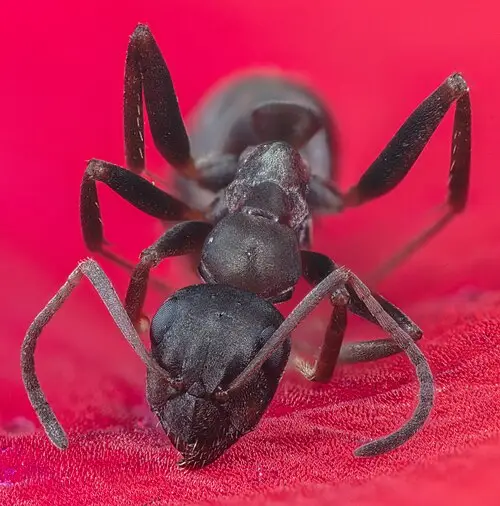
 📸 Photo
Photo: Diego Delso · CC BY-SA 4.0 · Wikimedia Commons Source
Pharaoh ant
Monomorium pharaonis (Pharaoh ant · Pharaoh ant)
Not Evaluated (NE) on the IUCN Red List yet.
💡 Everyday Comparisons for Size, Mass & Speed
- 💡 A body length of 1–2 mm is 1/13 to 1/26 the diameter of a Korean 500-won coin (26.5 mm) (Comparison).
- 💡 Living in wall crevices indoors, it is drawn to crumbs and sweets and even appears in hospitals attracted to used bandages. By clearing away leftover food, it also helps reduce household pests such as cockroaches (ADW).
Reference standards: coach bus ~12 m, mid-size car ~4.9 m, compact car ~1 t, basketball hoop 3.05 m, credit card 8.56 cm.
📖 1. Overview
The pharaoh ant is one of the smallest ants, nesting in warm, hidden places such as inside the walls of human homes.
🦴 2. Anatomy & Morphology
Its body length is 1–2 mm and its color is reddish brown to pale yellowish brown. Each compound eye has 20 facets and each mandible has 4 teeth, and it uses its antennae to sense vibrations and aid vision in the dark.
🔍 3. Ecology & Behavior
It is omnivorous, eating sweet foods like jelly, sugar, honey, cake, and bread, fatty foods like pie, butter, liver, and bacon, and dead insects. Workers leave chemical trails to find food, and workers, queens, and winged ants live together in a nest.
🇰🇷 4. Connection to Korea
It is listed as 'Ae-jip-gae-mi' (Korean name) on the National List of Species of Korea.
📚 Sources & References
- • IUCN Red List: not evaluated (NE) — cross-checked with the Wikidata conservation-status entry
- • catalogueoflife.org — 4488W
- • 국가생물종목록(국립생물자원관) ktsn 120000029545 — https://species.nibr.go.kr/home/mainHome.do?cont_link=009&subMenu=009002&contCd=009002&ktsn=120000029545
- • wikidata.org — Q1141346
- • commons.wikimedia.org — File:Hormiga faraón (Monomorium pharaonis), Hartelholz, Múni
- • animaldiversity.org — Monomorium pharaonis
- • Silhouette: PhyloPic — author not recorded · CC0 1.0 (Related taxon silhouette — Martialis heureka)
Recorded dimensions are widely cited representative estimates from public literature and may vary by study or specimen.