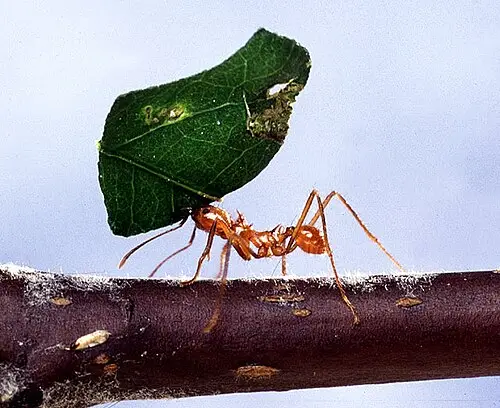
 📸 Photo
Photo: US gov · Public domain · Wikimedia Commons Source
Leaf-cutter ant
Atta cephalotes (Leaf-cutter ant · ケファロテスハキリアリ)
Not Evaluated (NE) on the IUCN Red List yet.
💡 Everyday Comparisons for Size, Mass & Speed
- 💡 A worker ant of up to 14 mm is slightly more than half the diameter of a 500-won coin (26.5 mm).
- 💡 In the forest, they turn over soil, disperse nutrients, and serve as protein prey for other forest animals, though in agriculture they are also regarded as pests (University of Kansas publication; Oakland Zoo materials).
Reference standards: coach bus ~12 m, mid-size car ~4.9 m, compact car ~1 t, basketball hoop 3.05 m, credit card 8.56 cm.
📖 1. Overview
The leaf-cutter ant (Atta cephalotes) lives in humid tropical forests from southern Mexico to Brazil, cultivating fungus on leaf fragments for food. It is considered a widespread and abundant species (not evaluated by the IUCN).
🦴 2. Anatomy & Morphology
Worker ants vary in size according to their task, with head widths ranging from 0.7 mm to 5 mm. They have three pairs of spines on the back of the thorax, and use a sound organ on the abdomen to produce vibrations that reduce the force needed to cut leaves and summon nestmates.
🔍 3. Ecology & Behavior
Using fresh leaf fragments, they cultivate a special fungus (Leucoagaricus gongylophorus) in underground chambers for food, and the ants and fungus cannot survive without each other. A single colony houses one long-lived queen and millions of sterile worker ants.
🇰🇷 4. Connection to Korea
No direct record connecting this species to Korea has been found.
📚 Sources & References
- • IUCN Red List: not evaluated (NE) — cross-checked with the Wikidata conservation-status entry
- • catalogueoflife.org — JMBV
- • wikidata.org — Q1945635
- • commons.wikimedia.org — File:Leaf-cutting ant.jpg
- • clacs.ku.edu — leaf-cutter-ant
- • ielc.libguides.com — summary
- • ielc.libguides.com — diet
- • Silhouette: PhyloPic — author not recorded · CC0 1.0 (Related taxon silhouette — Martialis heureka)
Recorded dimensions are widely cited representative estimates from public literature and may vary by study or specimen.