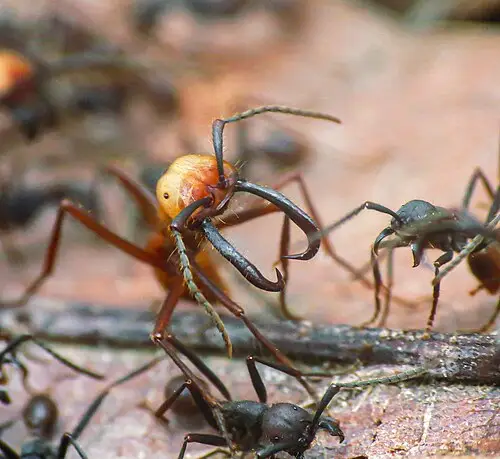
 📸 Photo
Photo: rodrigo_lazaro · CC BY 4.0 · Wikimedia Commons Source
Army ant
Eciton burchellii (Army ant · バーチェルグンタイアリ)
Not Evaluated (NE) on the IUCN Red List yet.
💡 Everyday Comparisons for Size, Mass & Speed
- 💡 The maximum worker length of 12 mm is less than half the diameter of a Korean 500-won coin (26.5 mm) (Comparison).
- 💡 It has the beneficial effect of removing agricultural and household insect pests (ADW).
Reference standards: coach bus ~12 m, mid-size car ~4.9 m, compact car ~1 t, basketball hoop 3.05 m, credit card 8.56 cm.
📖 1. Overview
The army ant is a nomadic ant living in warm, humid tropical forests, with colonies reaching 100,000 to 2,000,000 individuals that move their temporary nests (bivouacs) from place to place. There is no record of it on the National List of Species of Korea.
🦴 2. Anatomy & Morphology
Workers vary in size from 3 to 12 mm and look almost spider-like thanks to their long legs and long, sharp, hook-shaped mandibles. They use hooks on their feet to grip one another when forming bridges and temporary nests, and have a well-developed stinger.
🔍 3. Ecology & Behavior
Purely carnivorous, they raid prey in a large fan-shaped swarm, subduing victims with their stings and tearing off legs and antennae to carry back to the temporary nest. The raiding swarm spans several meters wide, and the single trail linking it to the nest can extend over 200 m.
🇰🇷 4. Connection to Korea
No direct record connecting this species to Korea has been found.
📚 Sources & References
- • IUCN Red List: not evaluated (NE) — cross-checked with the Wikidata conservation-status entry
- • catalogueoflife.org — 38MZZ
- • wikidata.org — Q288145
- • commons.wikimedia.org — File:Eciton burchellii - rodrigo lazaro - 323639271.jpeg
- • animaldiversity.org — Eciton burchellii
- • Silhouette: PhyloPic — author not recorded · CC0 1.0 (Related taxon silhouette — Martialis heureka)
Recorded dimensions are widely cited representative estimates from public literature and may vary by study or specimen.